The more you know, the harder you are to understand.
Curse of Knowledge
In a Stanford experiment, people tapped the rhythm of a song, others had to guess it. Tappers predicted about half would get it, actual rate: 2.5%. The song was obvious to the person hearing it in their head. The task captures the core problem: trying to transmit knowledge when you cannot ignore what is already in your own head.
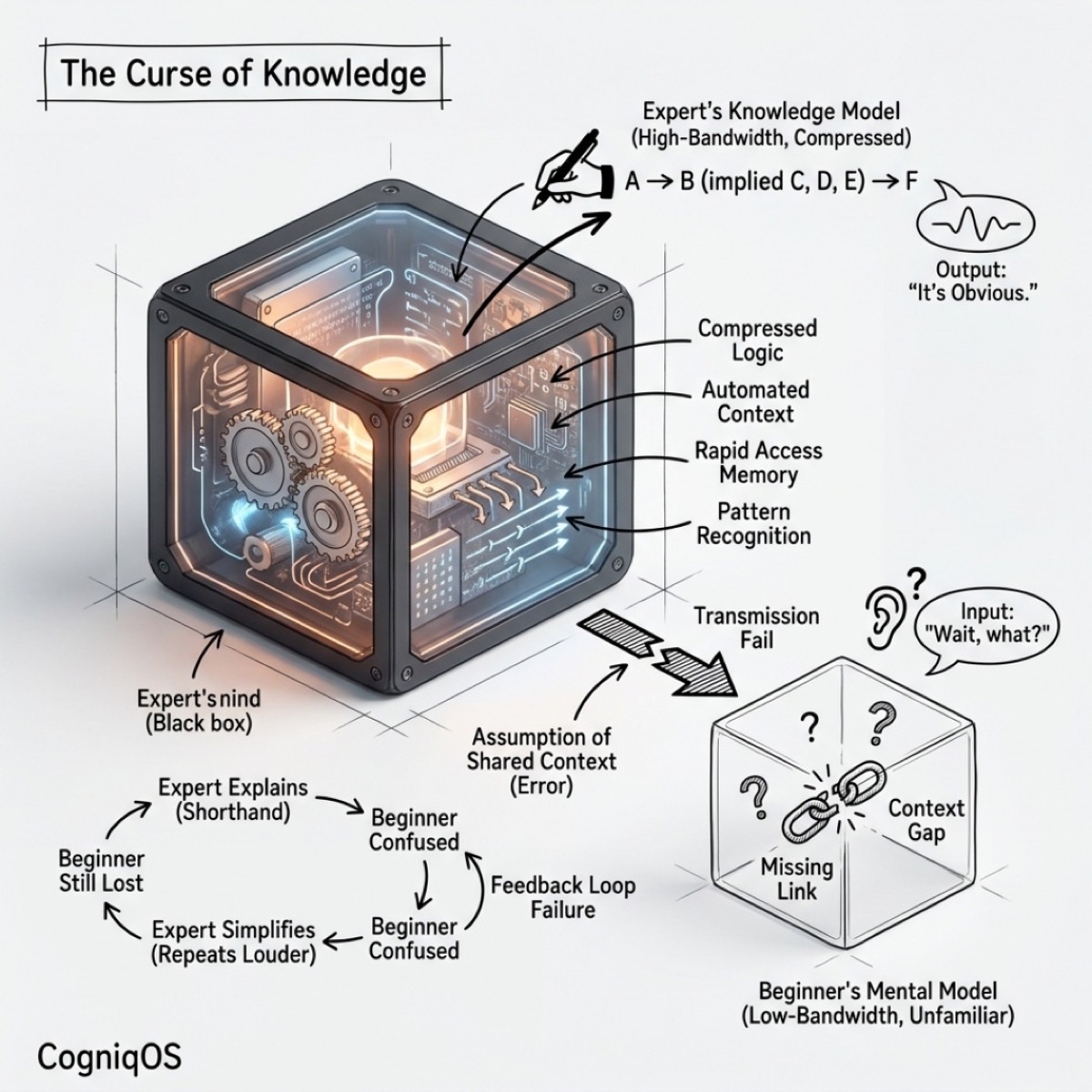
The curse of knowledge is the tendency to overestimate how understandable our explanations are to beginners and it has nothing to do with arrogance. No account of why has settled the question. One treats it as a structural failure of access, the expert has lost the ability to simulate not knowing. Another frames it as egocentric anchoring: starting from your own knowledge and adjusting away from it but never adjusting far enough. The distinction matters because the two accounts predict different interventions. Anchoring predicts deliberate adjustment should help. Access predicts external feedback should matter more than introspection.
By the end of this, you'll know why expertise makes explanation structurally harder and what the outsider test tests.
The more precise version: experts can explain things clearly. What they've lost is access to what it felt like not to know. They don't know what they're skipping.
Trying harder does not fix this on its own, introspection cannot rebuild a working model of what the beginner does not know. External feedback is usually more effective.
How it works
Once you know something, you can't reconstruct what it feels like not to know it. The knowledge doesn't sit next to your ignorance, it replaces it.
So when you explain, you skip steps, compress logic and assume context without realising it.
Not because people are unclear.
Because they are too clear to themselves.
Also shows up in
- Experts explaining basics to beginners
- Founders designing 'obvious' interfaces that baffle users. The onboarding flow that makes sense to the team and no one else
- Managers communicating strategy in shorthand that doesn't land
- Writers unintentionally writing for peers
- Expert witnesses reconstructing what was knowable at the time, who can no longer simulate not knowing it (hindsight/curse blend)
- Every 'why don't they just...' is a signal.
- The faster you learn, the less time you spend confused. Which means fewer memories of confusion and weaker models of beginner thinking. So capability increases but transmissibility can decrease. Software engineers show the same pattern. Given the same task, experts underestimated how long a novice would need by 35 to 40 percent, were worse predictors than people with intermediate experience and debiasing prompts barely moved their estimates (Hinds, 1999).
Countermeasure
Neither constraint asks you to reconstruct what it felt like not to know this, that access may be gone for good. Both substitute an external check for the internal one you cannot run.
Two constraints:
1. The outsider test - say it out loud to an intelligent person with zero context and watch for the moment they get lost. Rule of thumb: if they can't paraphrase the core in 30 seconds, simplify.
2. The missing piece - identify the one concept they don't have. Start there.
Explain one thing you know well to someone outside your field. And notice the first moment they lose the thread. That's where your explanation breaks.
Where it hurts most
- Code documentation. Developers can't reconstruct the reasoning behind their own decisions three months later (observational). The knowledge that produced the code has replaced the confusion that preceded it. The author and the reader, separated by ninety days, no longer share a mental model even when they're the same person.
- Customer support. A support engineer explains a fix using internal ticket shorthand the customer has never seen. The ticket gets marked resolved. The customer reopens it a week later, still stuck, because the explanation assumed context that was never shared (observational).
- Medicine. A specialist explains a diagnosis using terms that are second nature to them and a second language to the patient. The patient nods, signs the consent form and later cannot explain the procedure to their own family (observational).
When it doesn't apply
Among experts working in shared context, compression cuts the cost of transmitting information everyone already has. The curse hits when audience and expert no longer share that context.
Danger zone
Curse of Knowledge + Halo Effect + Fundamental Attribution Error - the expert communicates in terms that feel obvious to them, the audience's confusion gets attributed to lack of engagement rather than failure to explain and the Halo Effect makes the expert's confidence read as depth rather than opacity.
Stress test
1. The last time you explained something and got a blank look back, did you simplify or did you just repeat yourself slower and louder?
2. Pick the document, deck or briefing you are proudest of this year. Handed to someone outside your field with zero warm-up, how far would they get before losing the thread?
3. When a colleague asks you to explain the same thing twice, do you assume they weren't listening or do you check whether your first explanation named the concept they were missing?
4. Whose understanding are you currently assuming that you haven't tested?
Testable prediction
If people who have just learned a task estimate how long a novice will take to complete it, then those estimates run short of the actual time and the gap is larger for more expert estimators than for less expert ones.
Run this audit with your AI
Paste your decision in, and let your assistant audit it through this bias.
You are my CogniqOS jargon translator. Bias lens: Curse of Knowledge.

MY DECISION: [paste here]

One decision you're weighing, in a plain sentence - e.g. "Is my onboarding doc clear enough for a brand-new hire?"

What are my options and what does doing nothing cost? (Required.)

(Optional: who my audience is and what they already know.)

If another bias fits better, say so before auditing.

If my input is vague, ask me to sharpen it before auditing.

If it contains more than one decision, make me pick one first.

Audit:

1) List every assumption needed to understand this that my audience may not share.

2) Rewrite the core point for someone with zero domain context.

3) Who in the decision chain is most likely to misunderstand and why?

Calibration: don't strip useful precision. Flag only where shared context is assumed but absent.

Return as: the hidden assumptions + the zero-context rewrite + who is most likely to misread it.

Keep this in your stack. Next trap in the chain: Fluency Effect.
Related traps
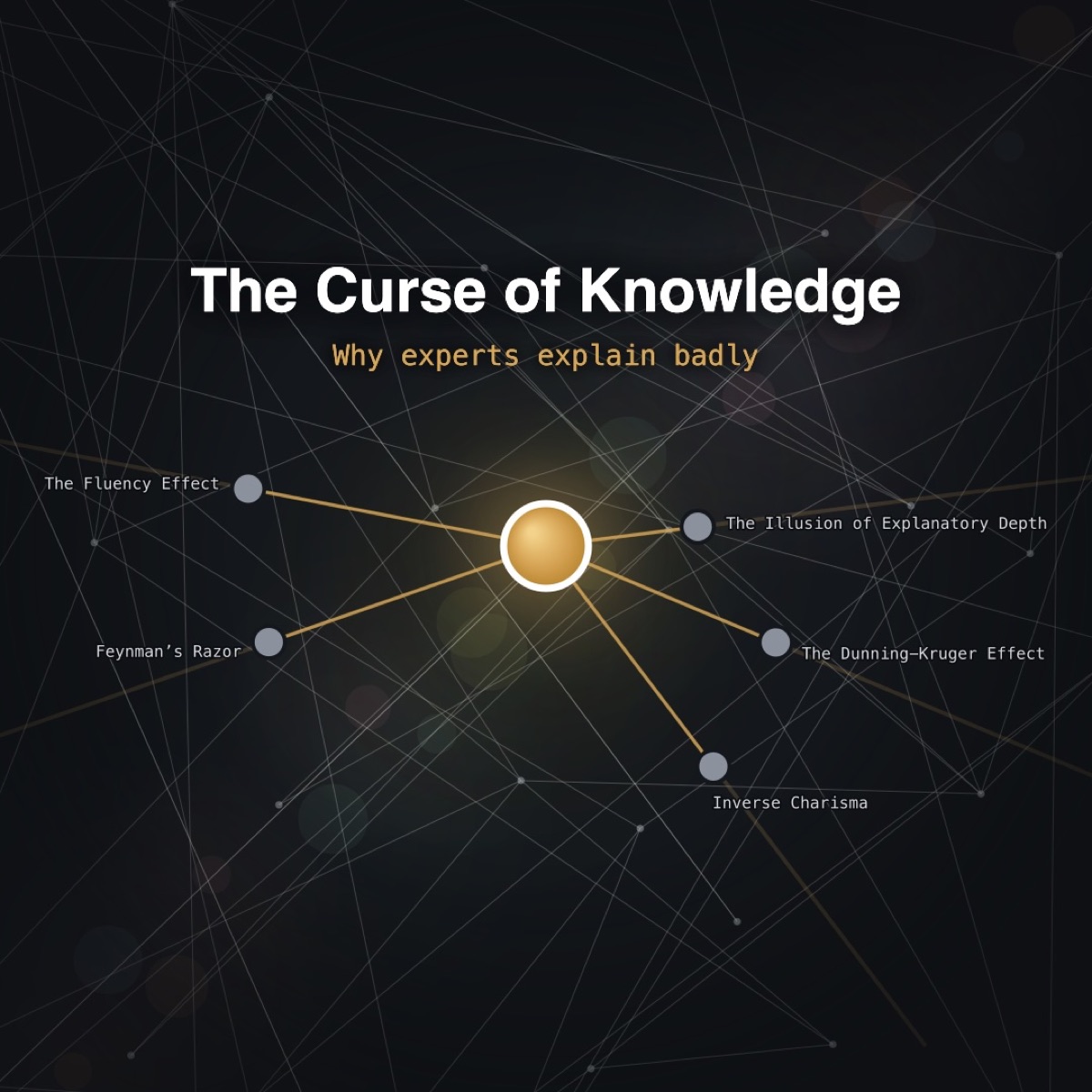
- Dunning-Kruger Effect - The opposite end of the calibration curve
- Fluency Effect - Easy-to-process information feels more true
- Illusion of Transparency - Overestimating how obvious your own understanding is to someone who does not share it
Also connected in the mapThe Fluency Effect·4 more, locked
Credit & first seen
DiscoveredHinds, P.J. (1999).The curse of expertise.Journal of Experimental Psychology: Applied 5(2), 205-221 source ↗
Sources
- Newton, E. (1990). The rocky road from actions to intentions. Unpublished doctoral dissertation, Stanford University
- Hinds, P.J. (1999). The curse of expertise: The effects of expertise and debiasing methods on predictions of novice performance. Journal of Experimental Psychology: Applied 5(2)
- Camerer, C., Loewenstein, G. & Weber, M. (1989). The curse of knowledge in economic settings: An Experimental Analysis. Journal of Political Economy 97(5), 1232-1254
- Glaser, J., Nouri, S., Fernandez, A., Sudore, R.L., Schillinger, D., Klein-Fedyshin, M. & Schenker, Y. (2020). Interventions to improve patient comprehension in informed consent for medical and surgical procedures: An updated systematic review. Medical Decision Making 40(2)
Read next
Entry #137 of 631 in The Lexicon · see the full Lexicon