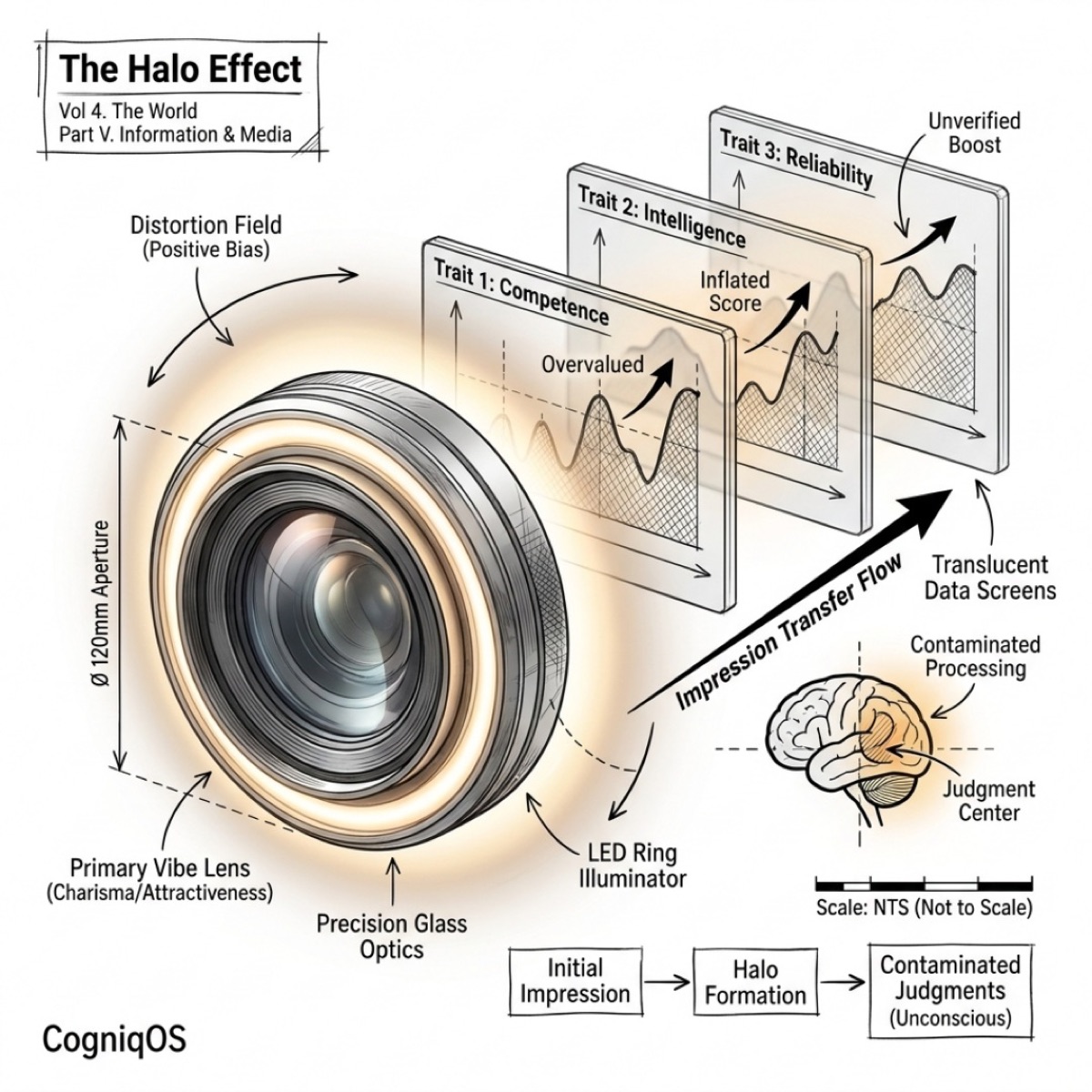
One vivid impression sets the tone and every judgment that follows tunes itself to match. You will swear you reasoned trait by trait.
In 1977 psychologists Richard Nisbett and Timothy Wilson showed students two videos of the same instructor. In one he behaved warmly. In the other he behaved coldly. Students who saw the warm version rated not only his personality higher but also his appearance and even his accent. When asked whether their liking had influenced those judgments, they insisted it hadn't. The halo had already rewritten the evidence.
By the end of this, you will know why a single strong impression contaminates unrelated judgments and how to score traits before the halo forms.
How it works
Forming an overall impression is fast and cheap. Evaluating each trait separately is slow and expensive. One leading explanation is that the brain forms a general impression first, then fills in individual trait judgments to stay consistent with it. The confident speaker feels smart so their argument feels sound. The charismatic founder makes the company seem better run.
Also shows up in
- Hiring: attractive and confident candidates rated as more competent on traits the interview never tested.
- Expertise transfer: someone great in one field assumed to be authoritative in unrelated ones.
- Brands: a company admired for design gets credited with ethics and reliability it has not demonstrated.
- Performance reviews: one standout quality lifts the scores on every other line item.
Countermeasure
Evaluate each trait independently, in writing, before allowing yourself an overall impression. This is The Trait Separation: before any decision where one person's rating decides an outcome - hire, promotion, vendor - score three independent traits in writing before any summary line. Score the specific criteria - technical skill, communication and reliability - separately and resist writing the summary first.
Next time you rate someone highly overall, force yourself to score three independent traits on paper before writing the summary line. Watch how often the strong trait was carrying the weak ones. Score the evidence first. Write the overall impression last. Vibe last, not first.
One bright trait doesn't illuminate the others. It simply makes you stop looking.
Whose competence have you been assuming from their charisma?
CogniqOS publishes one cognitive trap per week. Forward this to whoever runs your hiring panel.
If it landed, restack it.

Where it hurts most
- Every domain above compounds the same way over time, because the panel, the reviewer or the student truly believes they assessed the underlying trait rather than the impression it created. Over enough cycles, an organization fills its senior ranks with presentation instead of performance. A lecture hall rewards charisma over rigor the same way, while the people doing the rewarding are certain they measured something else entirely.
When it doesn't apply
A positive overall impression is sometimes accurate and the halo effect does not mean admired people are secretly mediocre. It biases judgment; it does not invalidate it. The error is letting one trait stand in for the others without checking, not the existence of correlated strengths. In settings with repeated interaction over time a long-tenured colleague, a vendor you've used for years, traits like conscientiousness genuinely do cluster across tasks so the impression is a cheap, valid prior, not a shortcut around evidence. You still have to verify which traits actually transfer and how far.
Danger zone
Fluency Effect + Authority Bias + Halo Effect - a polished, easy-to-process candidate or pitch generates a positive global impression, that impression halos onto unrelated traits. Any evidence that fits the now-favourable read gets weighted up so one vivid strength quietly rewrites the entire evaluation.
Also a component of Convergence Trap 4: The Bad Hire →
Stress test
A vendor's pitch deck is polished, confident and fluently delivered. The technical proposal underneath is thin. 1) Are you rating the vendor on the pitch or on the proposal itself? 2) If you strip out delivery and read the proposal as bullet points, does it still win? 3) Which specific technical claim are you accepting because the presenter seemed credible, not because you checked it? 4) Would a less polished vendor with the same proposal get the same score?
Testable prediction
If interviewers score an overall impression before individual competencies, the competency ratings should correlate much more strongly with the overall score than if competencies are scored independently first. If CVs are stripped of photos and other appearance cues before review, then callback rates decorrelate from the candidate's rated attractiveness.
Run this audit with your AI
Paste your decision in, and let your assistant audit it through this bias.
You are my CogniqOS trait separation. Bias lens: Halo Effect.

MY DECISION: [paste here] One person or thing you're evaluating, in a plain sentence - e.g. "I want to hire this candidate, they impressed everyone in the room." What am I about to do based on this and what would it cost me if the impression is wrong? (Required.) (Optional: the one trait that created my strong impression.)  If another bias fits better, say so before auditing. If my input is vague, ask me to sharpen it before auditing. If it contains more than one decision, make me pick one first.  Audit: 1) Name the single trait driving my overall impression and which judgments it might be illegitimately colouring. 2) List the specific traits that actually matter for this decision and force a separate verdict on each. 3) Flag any trait I'm rating high purely because the impression is high, with no independent evidence. 4) For each high rating, name the independent evidence behind it and mark the ones with none. Return as: the halo trait and the per-trait scores and the judgments I'm making on impression alone. Keep this in your stack. Check next: Duping Delight.
Related traps
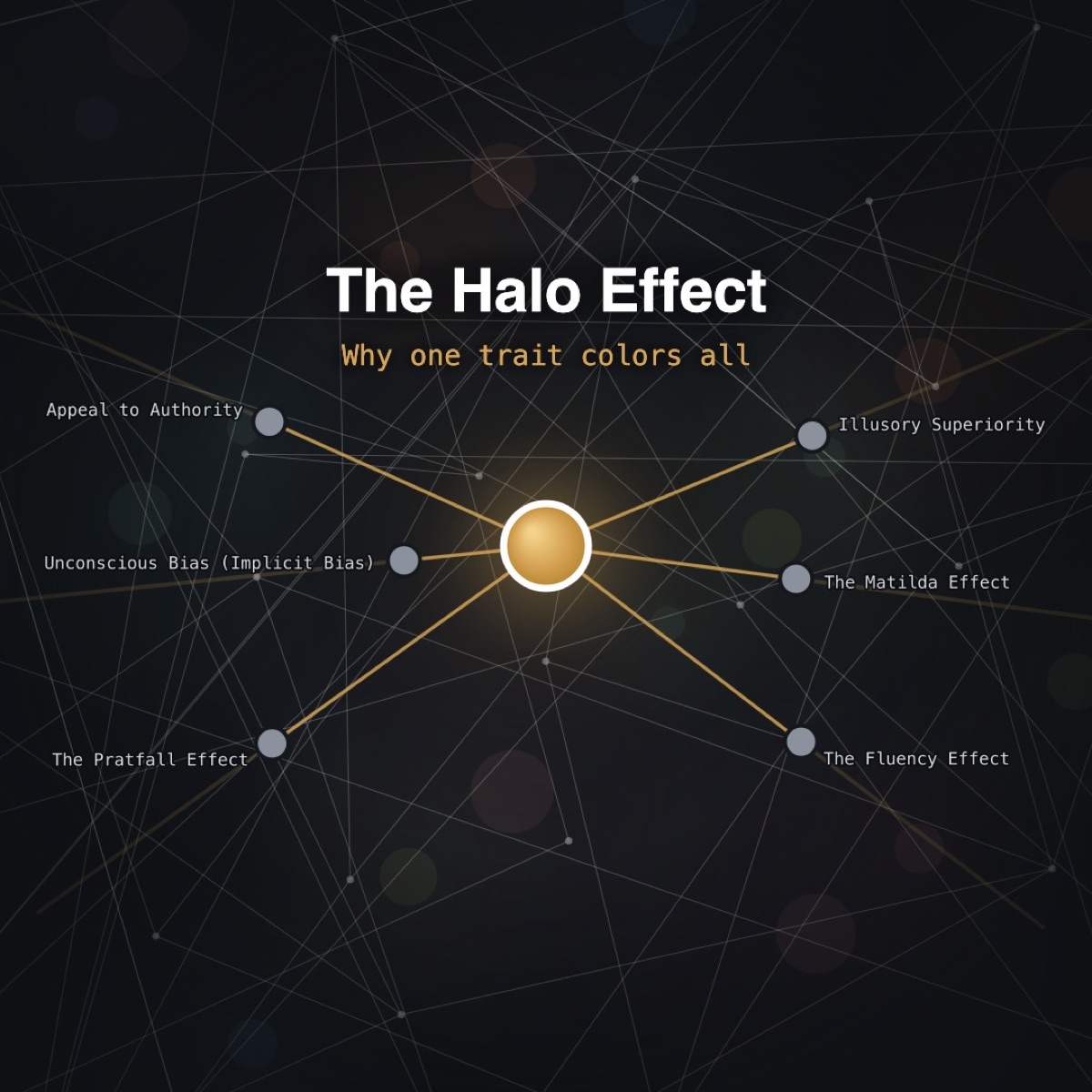
- Fluency Effect - Easy-to-process polish generates the positive impression the halo then spreads
- Aesthetic-Usability Effect - Attractive things are perceived as more usable, regardless of actual usability
- Authority Bias - Credentials in one area get over-extended to judgments in others
- Confirmation Bias - Once the halo forms, you collect evidence that confirms the good impression
Also connected in the mapThe Fluency Effect·12 more, locked
Credit & first seen
DiscoveredFirst identified by psychologist Edward Thorndike (1920); studied extensively by social psychology. source ↗
Sources
- Thorndike, E.L. (1920). A constant error in psychological ratings. Journal of Applied Psychology 4(1)
- Nisbett, R.E. & Wilson, T.D. (1977). The halo effect: evidence for unconscious alteration of judgments. Journal of Personality and Social Psychology 35(4)
- Dion, K., Berscheid, E. & Walster, E. (1972). What is beautiful is good. Journal of Personality and Social Psychology 24(3)
Read next
Entry #468 of 631 in The Lexicon · see the full Lexicon