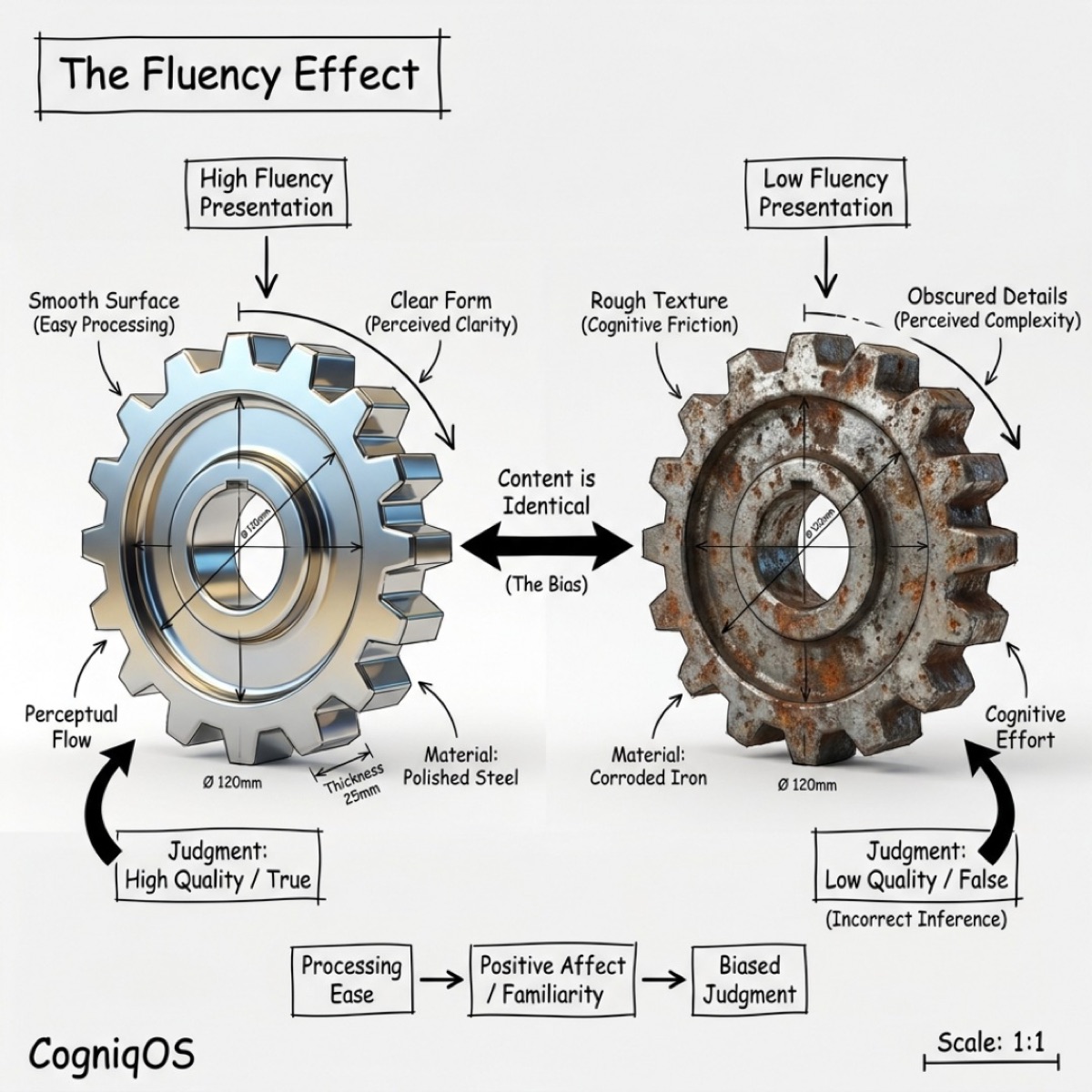
Good design can start persuading before the argument begins.
Two slide decks make the same claim. One has clean type and confident spacing, the other is rough notes. The polished one can feel more rigorous and more actionable, even when the content is identical.
By the end of this, you will know why processing ease gets mistaken for truth and how to strip the fluency back out before you judge.
True and incomplete. The problem is not that polish helps, it is that polish gets read as evidence. Your brain can treat how easily a claim goes down as a signal that it is correct, even when the ease came from the presentation rather than the evidence.
How it works
When something is easy to process, that ease feels like a quality of the claim rather than a quality of the format. The feeling is real and the inference is wrong. In one study, people rated invented food additives as more harmful when the names were hard to pronounce: Hnegripitrom was judged riskier than Magnalroxate, on nothing but the difficulty of saying it. A later replication study (pdf) found the effect did not generalise to newly constructed names, a useful warning against treating one vivid demonstration as a universal law.
Fluency isn't one thing. It can be visual, verbal or social, easy to see, easy to say or delivered with confidence. Same shortcut every time: ease gets mistaken for correctness.
When the format is easy, the claim feels solid even though nothing about the content was checked. The same shortcut inflates truth judgments and quality judgments alike: a polished argument can feel more correct, a polished proposal can feel more competent.
Also shows up in
- A strategy deck with clean typography rated as more rigorous than the same strategy in rough notes.
- A harder-to-process speaker can feel less credible, even when the message is the same.
- An argument that rhymes or uses simple words landing as more true than a precise but clunky version.
Countermeasure
Restate the important claim in plain words, yourself, before you judge it.
[PULL QUOTE - blockquote this line in Substack, then delete this marker] If it only feels true when delivered fluently, the fluency is doing the work and the content is not.
Stripping the polish is the test. Then ask what would convince you if this arrived as ugly notes from a source you disliked.
Take the most persuasive slide in a deck you are reviewing. Rewrite its claim as one flat sentence with no formatting. If it stops feeling convincing, you were rating the design.
Fluency is not evidence, it is a feeling of ease. Ease was never what made something true.
What is the last thing you agreed with mainly because it was easy to follow?
CogniqOS publishes one cognitive trap per week. Forward this to whoever just got talked into something by a beautiful deck.
If it landed, restack it.
Where it hurts most
- High-stakes evaluation under time pressure. A hiring panel, an investment committee, a review board: the clean, confident version reads as the more rigorous one. The judgment that is supposed to track the merits tracks the presentation instead.
When it doesn't apply
Sometimes the easy-to-process version really is clearer and better structured and preferring it is not irrational. Good writing earns trust honestly. The bias bites when fluency gets weighted beyond what its actual correlation with accuracy warrants. The only way to know that weight is right is to check the content directly.
Danger zone
Confirmation Bias + Halo Effect + Fluency Effect - a smooth, well-designed argument that already matches what you believe gets a competence halo and a truth bump at the same time so prior belief, source impression and processing ease all push one direction and there is no internal signal left that says check this.
Also mapped in Cross-Domain Transfer: Education & Learning →
Stress test
Two vendor proposals. Vendor A has a designer, clean templates, confident copy. Vendor B sent a dense document with the actual implementation risks spelled out. The committee leaves the room describing A as more professional and more credible. Nobody noticed that B was the only one who disclosed where the project could fail.
Testable prediction
If the same claim is made easier to process through repetition, familiarity or clear presentation, then agreement or confidence increases even when the evidence is unchanged. The increase is usually small but reliable. It varies by material and by how the claim was first encountered. If readers are prompted to separate presentation from content, then the effect shrinks but does not disappear.
Run this audit with your AI
Paste your decision in, and let your assistant audit it through this bias.
You are my CogniqOS fluency strip. Bias lens: Fluency Effect.

MY DECISION: [paste here]

One claim or proposal you're evaluating, in a plain sentence - e.g. "Should I go with the vendor whose pitch felt the most polished?"

What am I about to do based on this and what would it cost me if the impression is wrong? (Required.)

(Optional: what made it feel persuasive - design, delivery, confidence.)

If another bias fits better, say so before auditing.

If my input is vague, ask me to sharpen it before auditing.

If it contains more than one decision, make me pick one first.

Audit:

1) Restate the core claim in one flat sentence with all polish removed. Does it still hold up?

2) Separate what I actually know about the content from what I'm inferring from how it was presented.

3) Tell me what evidence I'd need to evaluate this if it had arrived as rough notes instead.

4) Tell me which parts of my confidence look evidence-based and which look presentation-driven. Is what's left enough to act on?

Return as: the stripped claim + the content-vs-presentation split + the evidence I'm still missing.

Do not reward polish. Do not punish awkward presentation.

Keep this in your stack. Next trap in the chain: The Bias Blind Spot.
Related traps
- Halo Effect - One positive impression, like polish, bleeds into judgments of unrelated traits
- Keats Heuristic - A rhyming statement feels more true than a non-rhyming one that says the same thing
- Confirmation Bias - Fluency and prior belief reinforce each other in the same direction
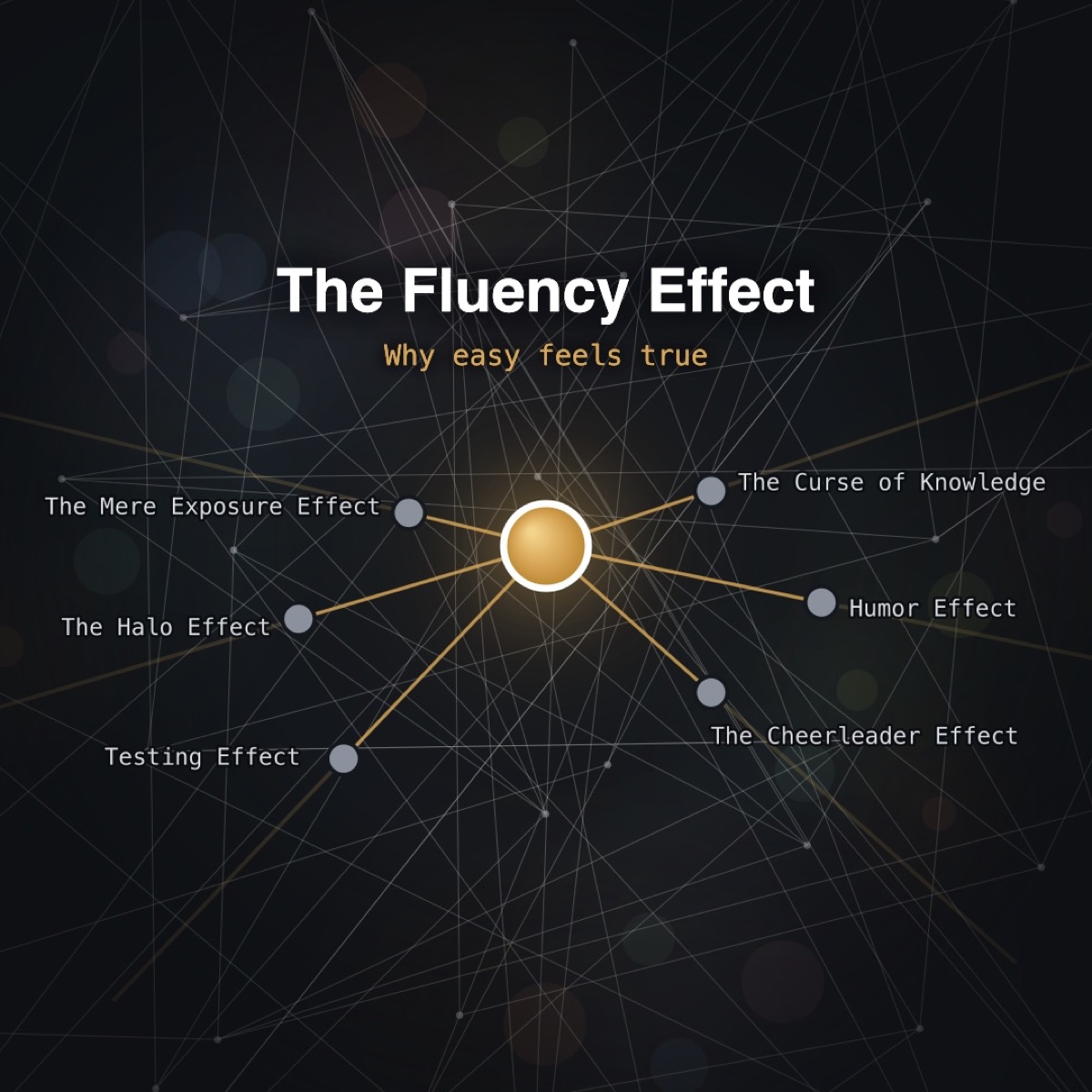
Also connected in the mapThe Curse of Knowledge·The Halo Effect·10 more, locked
Credit & first seen
DiscoveredDocumented by Reber, Winkielman & Schwarz (2004); Alter & Oppenheimer (2006). source ↗
Sources
- Reber, R. & Schwarz, N. (1999). Effects of perceptual fluency on judgments of truth. Consciousness and Cognition 8(3), 338-342
- Alter, A.L. & Oppenheimer, D.M. (2006). Predicting short-term stock fluctuations by using processing fluency. PNAS 103(24), 9369-9372
- Song, H. & Schwarz, N. (2009). If it's difficult to pronounce, it must be risky. Psychological Science 20(2), 135-138
- Bahník, Š. & Vranka, M.A. (2017). If it's difficult to pronounce, it might not be risky. Psychological Science 28(4), 427-436
Read next
Entry #20 of 631 in The Lexicon · see the full Lexicon