You rated the risk. Check which question you actually answered.
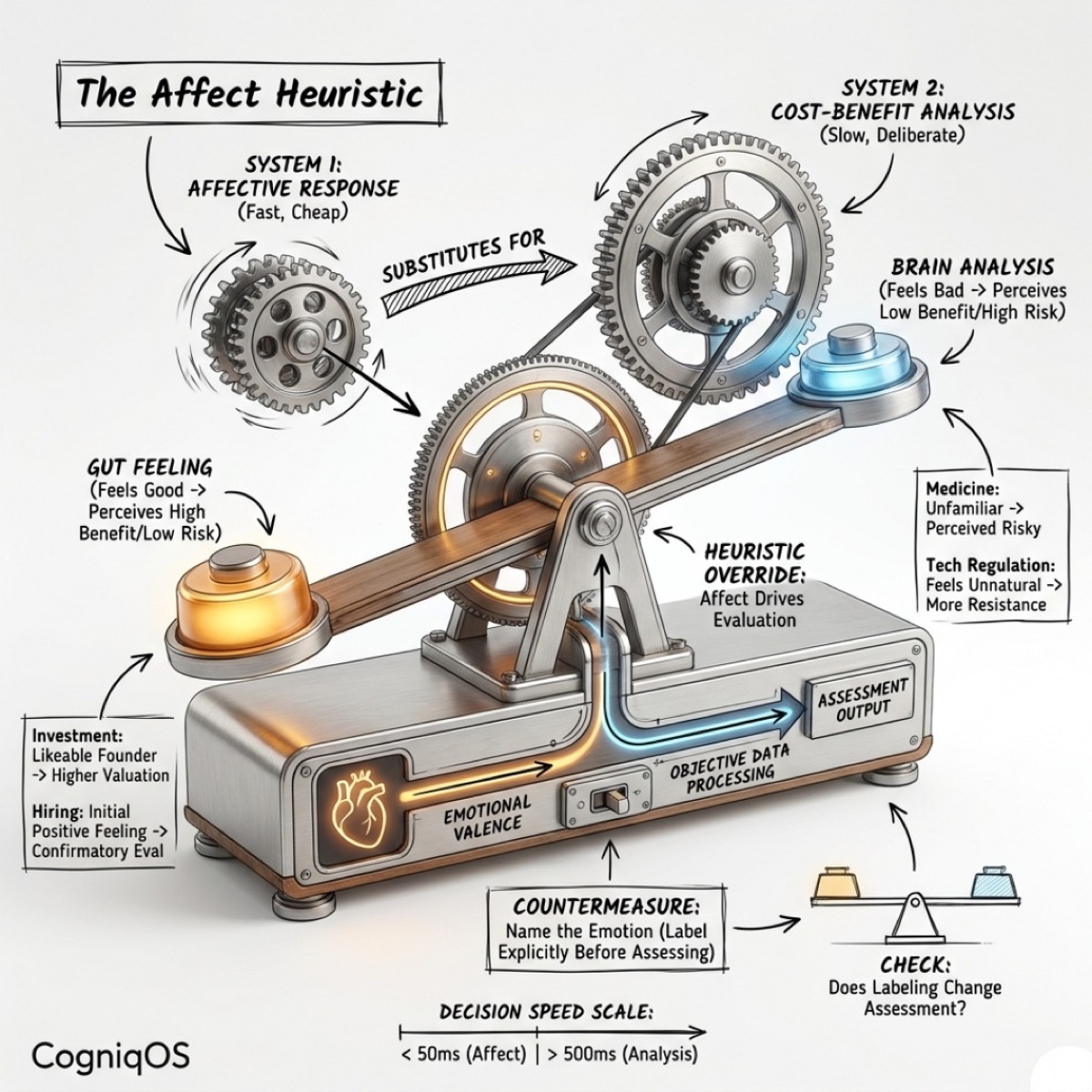
Paul Slovic and colleagues documented a pattern in risk and benefit judgements. When people feel good about an option, they tend to rate it as simultaneously high-benefit and low-risk. When they feel bad about it, they rate it as simultaneously low-benefit and high-risk: the entire cost-benefit calculation compressed into a single signal. Fast and cheap.
By the end of this, you'll know how emotional responses substitute for cost-benefit analysis without announcing themselves.
Neither is the useful version. The affect heuristic isn't about gut feelings being good or bad. It's about affective responses substituting for cost-benefit analysis - producing assessments that track how something feels rather than what it delivers.
How it works
An affective response arrives fast, often before any deliberate analysis. That feeling then serves as information for judging the option: good-feeling options seem more beneficial and less risky, bad-feeling options seem less beneficial and more risky. The leading account is that a single affective signal supplies both the risk and benefit judgement at once. The feeling is not just informing the analysis. In many cases it is standing in for it.
For example: a product that 'feels premium' gets rated as safer, more effective and better value before the buyer has examined any data. The affect arrived first and did the analysis.
The question you answer isn't always the question you were asked. If you were asked 'what is the risk here?' but your gut was already answering 'how do I feel about this?', you may have answered the second one and reported it as the first.
Also shows up in
- Investment: a founder who feels trustworthy can make the opportunity itself feel safer and more attractive, before the unit economics are checked
- Medicine: a treatment that feels reassuring can seem safer before its evidence is examined
- Hiring: liking a candidate can spill into judgements of their competence and fit
- Technology regulation: a technology that feels unnatural can draw more resistance than a familiar one that carries similar risk
Countermeasure
The label-and-rerate check. For any decision that carries a strong feeling and a cost above a level that would sting to lose, run three steps before committing. First, name the emotion out loud: I feel uneasy, I feel excited. Second, rate the option twice on a 1 to 10 risk scale, once before the label and once after. Third, compare. If naming the emotion moves the rating, that is not proof of a mistake. It is the signal to ask whether the feeling was supplying information the evidence had not yet earned. Then ask:
Am I answering the question I was asked or the easier one my gut substituted?
Set the threshold in advance so the check fires on its own: for example, any decision above a month's income or any you would struggle to reverse, gets the label-and-rerate pass before you commit.
Where it hurts most
- Risk assessment in nuclear, chemical and environmental policy. Slovic's research found that public risk perception was driven more by dread and unfamiliarity than by actual mortality or injury data. The feeling of danger, not its magnitude, can become the main driver of perceived risk even when it does not track the statistical size of the harm.
When it doesn't apply
Expert intuition trained on thousands of cases encodes real information about risk and benefit. An experienced clinician's discomfort with a patient's presentation or an investor's unease about a deal's structure can be more accurate than deliberate analysis when the domain is well-calibrated. The affect heuristic is not emotion overriding facts. It is affect used as information and it works when experience has taught the feeling to predict the outcome. So the test is simple: has your gut been trained on many similar cases with clear feedback? If yes, give the feeling evidential weight. If no, interrogate it. The heuristic fails specifically when affect tracks something other than actual risk: aesthetics, branding, familiarity or the likability of the person presenting.
Danger zone
Affect Heuristic + Availability Heuristic + Risk Perception - emotional reactions make an outcome feel dangerous, availability makes vivid outcomes easier to recall and together they push perceived risk toward emotional salience rather than statistical frequency, distorting both what gets insured and what gets ignored.
Also a component of Convergence Trap 5: The Panic Decision →
Stress test
Investor meets an articulate, passionate founder. Describes the meeting as "one of the best I've had." Their notes show almost no analysis of the business model, they invest. Affect toward the founder substituted for analysis of the opportunity, two separate variables processed as one.
Testable prediction
If people judge risks and benefits under time pressure, the inverse relationship between perceived risk and perceived benefit grows stronger than under no time pressure, reflecting heavier reliance on affect (Finucane et al., 2000).
Run this audit with your AI
Paste your decision in, and let your assistant audit it through this bias.
You are my CogniqOS emotion auditor. Bias lens: Affect Heuristic.

MY DECISION: [paste here]

One decision you're weighing, in a plain sentence - e.g. "I'm leaning toward rejecting this deal."

What are my options and what does doing nothing cost? (Required.)

(Optional: the feeling this decision gives me right now.)

If another bias fits better, say so before auditing.

If my input is vague, ask me to sharpen it before auditing.

If it contains more than one decision, make me pick one first.

Audit:

1) Name the emotional reaction. Rate intensity 1-10.

2) What do I feel? What do the facts say? Side by side.

3) Valence flip: if the emotion reversed, would my risk/benefit assessment change? If yes, affect is driving.

Return as: the emotion + the facts side by side + the valence-flip result.

Keep this in your stack. Next trap in the chain: Availability Heuristic.
Related traps
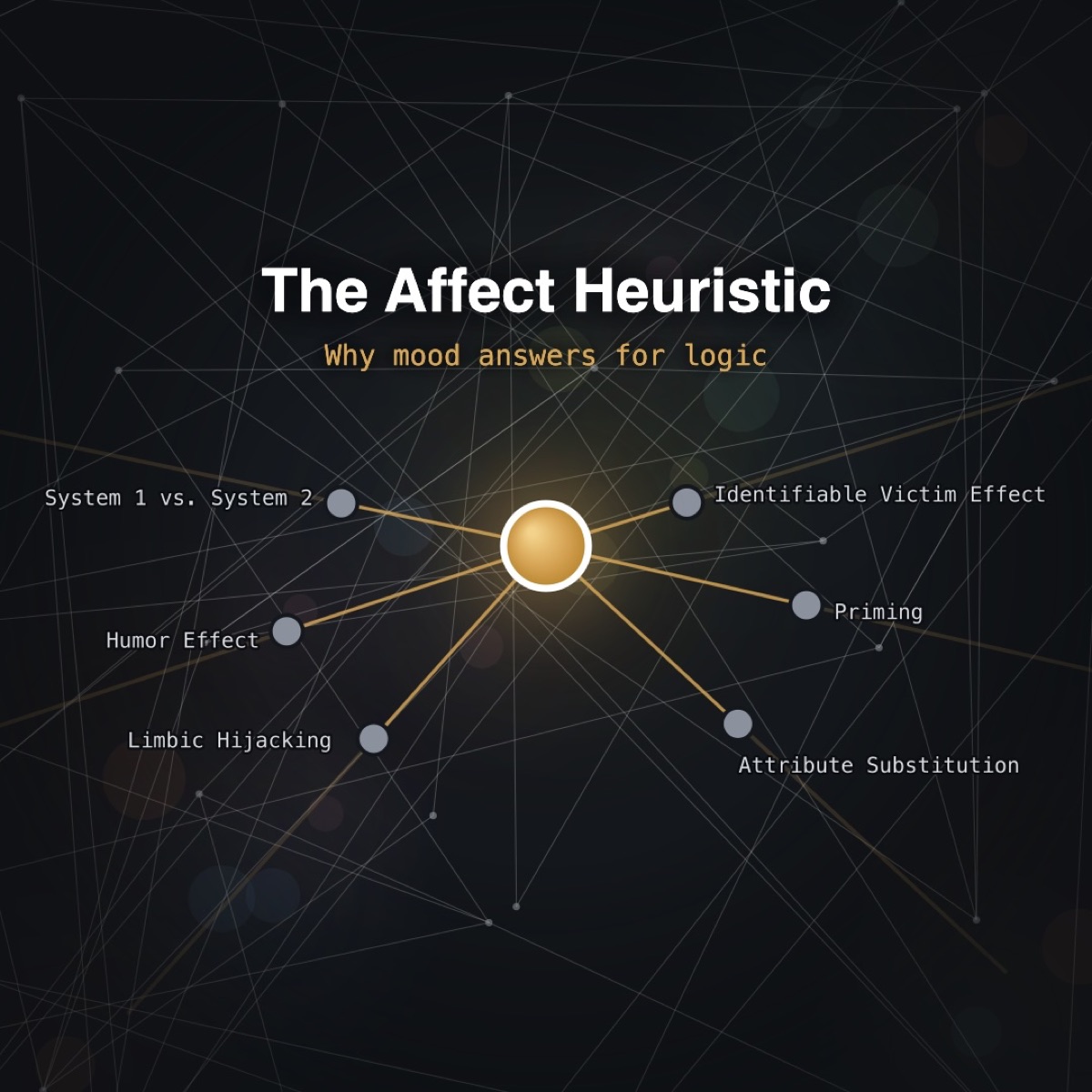
- Attribute Substitution - Answering an easier question than the one that was asked
- Halo Effect - One positive attribute generalises to all attributes
- Availability Heuristic - Vivid emotional responses make events feel more probable
Also connected in the map10 more, locked
Credit & first seen
DiscoveredSlovic, P. et al. (2002).The affect heuristic.In T. Gilovich, D. Griffin,&D. Kahneman (Eds.), Heuristics and Biases. Cambridge University Press source ↗
Sources
- Finucane, M.L., Alhakami, A., Slovic, P. & Johnson, S.M. (2000). The affect heuristic in judgments of risks and benefits. Journal of Behavioral Decision Making 13(1)
- Peters, E. & Slovic, P. (1996). The role of affect and worldviews. Journal of Applied Social Psychology 26(16)
- Slovic, P., Finucane, M.L., Peters, E. & MacGregor, D.G. (2002). The affect heuristic. In Gilovich, Griffin & Kahneman (Eds.), Heuristics and Biases: The Psychology of Intuitive Judgment
- Slovic, P., Peters, E., Finucane, M.L. & MacGregor, D.G. (2005). Affect, risk, and decision making. Health Psychology 24(4S)
Also revealed
Entry #1 of 631 in The Lexicon · see the full Lexicon