You just read a book about cognitive biases. You now spot them everywhere - in your colleagues, your opponents, your relatives. Notice who is missing from that list.
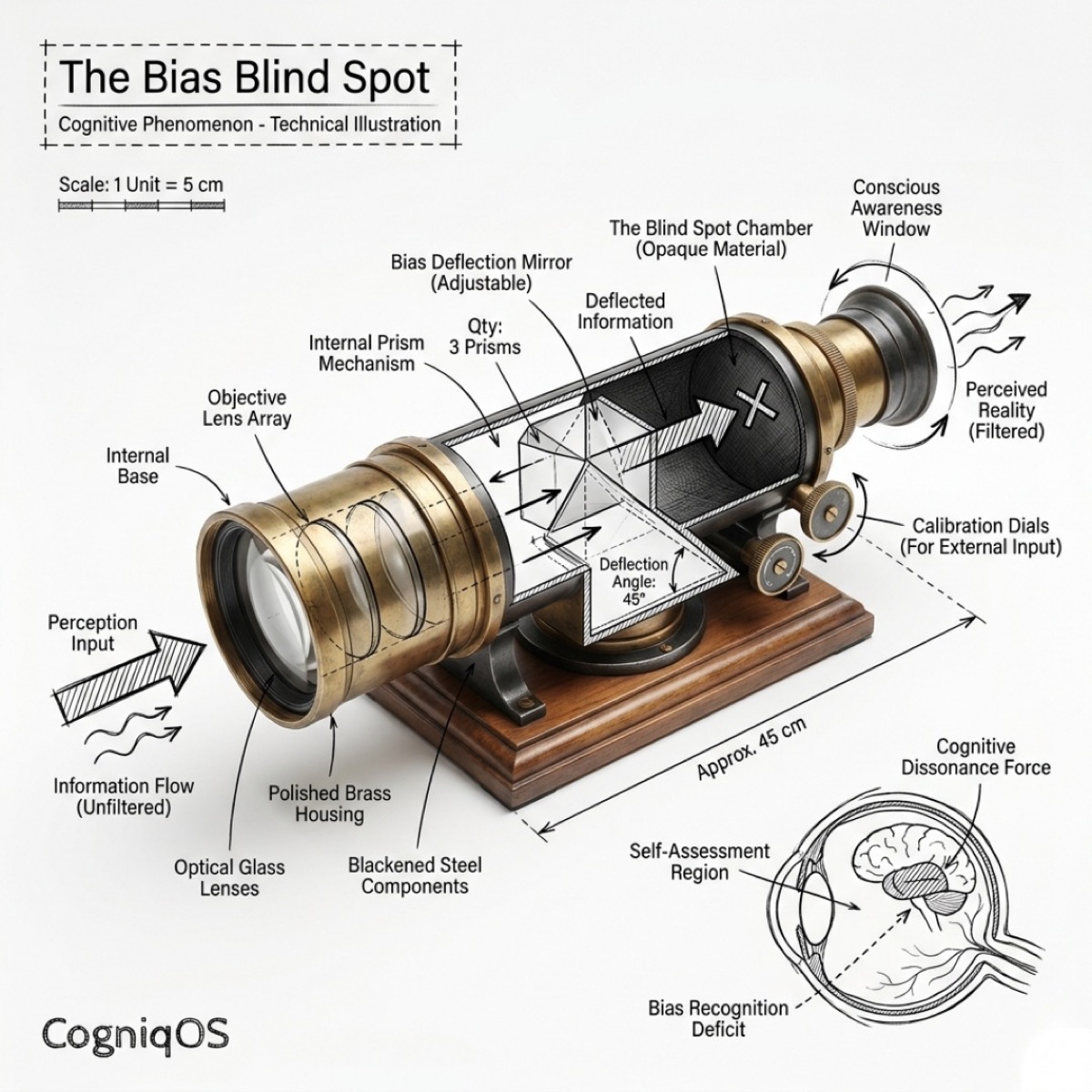
This is backwards. Learning bias vocabulary upgrades your detection hardware but you point that hardware outward. The competence gained is competence at diagnosis, not cure. Pronin's cross-sectional data shows a persistent gap between bias detection in self and others. Whether vocabulary training specifically widens that gap has not been established longitudinally.
The uncomfortable read: smart people are equally biased and better armed to deny it.
How it works
The primary account comes from Pronin, Lin and Ross (2002), who named the effect across student and adult samples. Their explanation rests on asymmetric access. You judge others by their behaviour - their conclusions, their motivated leaps. You judge yourself by introspection - the felt experience of weighing evidence and arriving at a conclusion that simply seems correct.
Bias operates below the level introspection can reach so a scan of your own reasoning returns nothing. The absence of a felt sense of bias reads as evidence of its absence. Whether the effect is fully structural or also driven by motivated cognition remains open.
West et al. (2012) found that higher cognitive ability - measured as a composite of cognitive ability assessments - does not attenuate the bias blind spot. That finding concerns measured cognitive ability specifically, not bias education or awareness training.
Also shows up in
- The effect fires hardest where it does most damage: high-stakes evaluation of your own work - peer review, leadership calls, self-assessment on projects you championed. A researcher fluent in motivated reasoning could plausibly produce among the most motivated reviews in the department, because fluency in naming the trap gets mistaken for standing outside it. This is an illustrative conjecture, not an established finding.
- Knowing about the bias does not fix it. One coherent explanation is that the correction most people apply - introspecting harder - relies on the very faculty that cannot see the problem. Pronin et al. (2002) offered asymmetric access as the structural explanation but did not experimentally test whether introspective effort specifically worsens the blind spot. West et al. measured cognitive ability, not domain expertise or bias education - those are meaningfully different constructs.
Countermeasure
Stop using self-assessment to check for bias. Your conviction that you are thinking clearly is uninformative for that specific purpose - treat it as noise, not signal. Introspection retains real value for knowing your intentions, effort and uncertainty. What it cannot do is reliably detect whether your reasoning has gone wrong.
[PROTOCOL: External Structure Override] Trigger threshold: any decision that is irreversible, costs more than you can absorb to unwind or where you find yourself reasoning that no external review is needed. Prescribed action: route the decision through at least one external process - a red-team review where someone attacks your reasoning, a premortem that assumes the decision failed and asks why or explicit base-rate anchoring before you form a view. Do this before committing.
Structural separation breaks the circuit the bias runs through - not because external reviewers are immune to bias but because the process runs outside your interior narrative. Keep a decision journal and audit it against actual outcomes.
These options are not equally available to everyone. Solo operators and junior employees in cultures that penalise challenge have narrower tools: explicit base-rate anchoring requires no organisational permission and a decision journal costs nothing. A sufficiently motivated reasoner can route around external review by selecting compliant reviewers. Where stakes permit, rotate reviewers, assign the attack role explicitly and treat the review as a process to design rather than a person to trust.
Where it hurts most
- Investing: an experienced investor dismisses a bearish thesis as the other side's cognitive distortion while running the identical distortion on their own position. This is an illustrative example of how the mechanism might play out, not a documented observational finding.
- Hiring and promotion: evaluators trained in interview bias apply the training to flag other people's snap judgements and rate their own gut read as calibrated experience. This is an illustrative example rather than a controlled or observational finding.
- Decision quality: Scopelliti and colleagues (2015) built a bias-blind-spot scale and found that people scoring higher on it were, on average, less receptive to advice and made poorer decisions on the tasks studied - the blind spot tracks worse real behaviour, not just self-report (medium confidence, single study).
When it doesn't apply
The asymmetry is not pure malfunction. You do have privileged access to your own intentions and effort - you know when you tried to be fair even if you failed and that information is real. Introspection is unreliable for one specific task: detecting your own bias.
The environment where the heuristic wins: routine, reversible, low-stakes calls where the feedback loop closes fast enough to correct mistakes. Self-trust is tolerable there because the consequences of the structural blind spot are absorbable. Irreversible high-stakes decisions cannot afford it - not because introspection suddenly fails there but because the consequences of its structural limit are no longer recoverable.
Danger zone
Dunning-Kruger + Confirmation Bias + Bias Blind Spot - this named cluster is self-sealing in a specific sense: the person lacks the skill to see their errors and believes they are immune to the biases producing them. Disconfirming evidence gets attributed to bias in others rather than in themselves. The self-sealing quality applies to internal correction and to poorly designed external correction - a motivated reasoner can partially re-seal external review by choosing compliant reviewers or scoping the review to exclude vulnerable reasoning. It is not a property of all external correction. Replication researchers have contested the Dunning-Kruger component; see that entry before treating this compound as settled.
Also a component of Convergence Trap 3: The Overconfident Expert →
Stress test
1. You spot that a peer cherry-picked supporting citations. Have you applied the same audit to your own last proposal or did you assume yours was clean?
2. When you last changed your mind on something important, was it because of internal reflection or because an external process forced disconfirming evidence in front of you?
3. Name the last decision where you deliberately assigned someone to attack your reasoning - not as a formality but in a way that gave them real licence to find it wrong. If you cannot name one, what makes you think your reasoning has survived genuine challenge?
4. You rate yourself as more objective than your average colleague. On what external evidence, as opposed to your felt sense of clarity?
5. In which recent high-stakes call did your fluency with bias terminology substitute for an actual structured check?
Testable prediction
If you inform a person about a specific named bias, their detection of that bias in others may increase while their detection of it in themselves remains unimproved. Measurable variable: the gap between self-rated bias susceptibility and other-rated bias susceptibility before and after vocabulary training, compared against an untrained control group. The cross-sectional pattern in Pronin (2002) showed a persistent gap between self and other detection but did not track individuals longitudinally. The causal direction of bias-naming on self-detection remains open rather than established. If you measure cognitive ability, the bias blind spot persists rather than narrowing. West et al. (2012) used a composite of cognitive ability measures and found no evidence that higher cognitive ability closes the gap. Comparison: high-cognitive-ability group versus low-cognitive-ability group on the self-other detection gap. West et al. did not manipulate bias education or vocabulary knowledge so their result cannot confirm that naming biases specifically fails to close the gap - only that cognitive ability of the kind they measured does not.
Run this audit with your AI
Paste your decision in, and let your assistant audit it through this bias.
Use this to audit a decision for the Bias Blind Spot - the tendency to detect bias in everyone but yourself.

MY DECISION: [paste here]

Audit:

1. Where did I rely on my own felt sense of thinking clearly as evidence that I am unbiased?

2. If a colleague I consider biased had produced this exact reasoning, which biases would I name in it?

3. What external process - red team, premortem, base-rate check - did I actually run, as opposed to introspecting harder?

4. Am I treating my fluency with bias terminology as a substitute for a structured check?

5. Is this decision irreversible or does it cost more than I can absorb to unwind? If so, has someone been assigned to run external review and if I concluded it did not need review, how confident am I that conclusion was not itself an expression of the blind spot?

6. What disconfirming evidence have I dismissed and did I attribute that dismissal to a flaw in the source rather than in myself?

Keep this in your stack.

Next trap in the chain: The Introspection Illusion.
Related traps
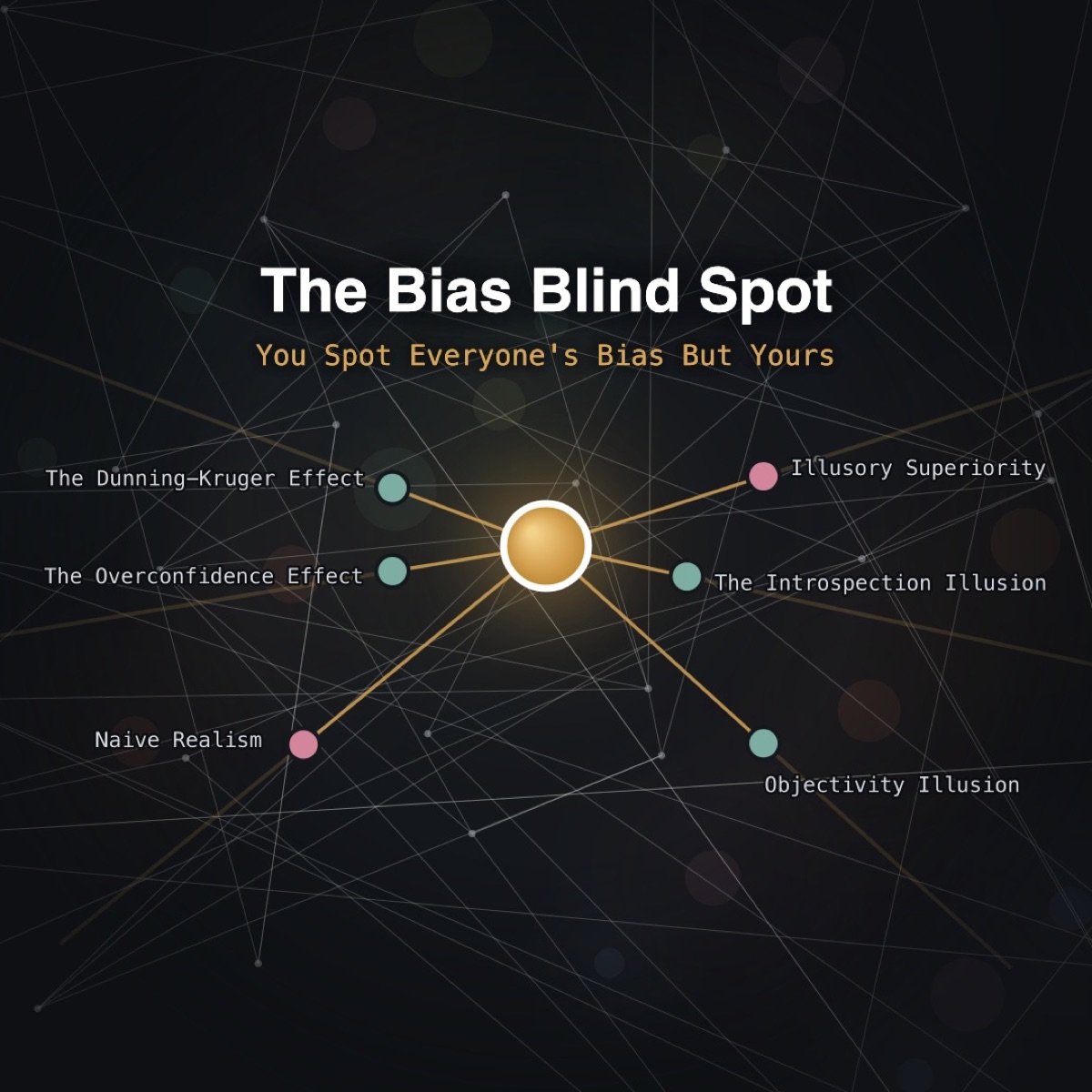
- Introspection Illusion - supplies a candidate mechanism: you overweight the contents of your own mind as evidence about your objectivity. This extends the asymmetric-access account described in the Mechanism section.
- Overconfidence Effect - compounds the blind spot by inflating trust in the very self-assessment that cannot detect the bias. The Overconfidence Effect entry contains the evidentiary basis for this link.
- Dunning-Kruger Effect - the pairing runs in two directions. Low-competence individuals may develop confident bias-immunity where self-insight is lowest; sophisticated people whose fluency with bias vocabulary causes self-scrutiny to relax face the same problem by a different route. These are not the same population or the same mechanism - treat the pairing as a live tension rather than a settled compound risk. Replication researchers have contested the Dunning-Kruger Effect; see that entry for the current evidentiary state.
- Naive Realism - frames your own view as the objective baseline and others' as distorted, mapping onto the outward-pointing detector described here. Both effects share the structure of treating one's own perspective as the unpolluted reference point. The Naive Realism entry develops where researchers have challenged that framing.
Also connected in the mapThe Introspection Illusion·10 more, locked
Credit & first seen
DiscoveredPronin, E., Lin, D.Y.&Ross, L. (2002).‘The Bias Blind Spot: Perceptions of Bias in Self Versus Others.’Personality and Social Psychology Bulletin 28(3), 369-381 source ↗
Sources
- Pronin, E., Lin, D.Y. & Ross, L. 2002 - The Bias Blind Spot: Perceptions of Bias in Self Versus Others. Personality and Social Psychology Bulletin 28(3), 369-381.
- Pronin, E. & Kugler, M.B. 2007 - Valuing thoughts, ignoring behavior: The introspection illusion as a source of the bias blind spot. Journal of Experimental Social Psychology 43(4), 565-578.
- West, R.F., Meserve, R.J. & Stanovich, K.E. 2012 - Cognitive sophistication does not attenuate the bias blind spot. Journal of Personality and Social Psychology 103(3), 506-519.
- Scopelliti, I., Morewedge, C.K., et al. 2015 - Bias Blind Spot: Structure, Measurement, and Consequences. Management Science 61(10), 2468-2486.
Read next
Entry #9 of 631 in The Lexicon · see the full Lexicon