
You are far less legible than you feel.
You are about to speak and your heart is going. It feels obvious, like the whole room can see it. Usually, they cannot. Your anxiety, your irritation, your fondness for someone across the table: mostly invisible, far quieter on the outside than it is in your head.
By the end of this, you will know why your internal emotional state feels broadcast when it is barely leaking and what to do with that in the moments it matters.
Backwards. Whatever leaks is far weaker than it feels from the inside. Your felt nerves are vivid to you and dim to everyone else. The advice should be the reverse: assume your state is less visible than it feels and respond to the words in front of you.
How it works
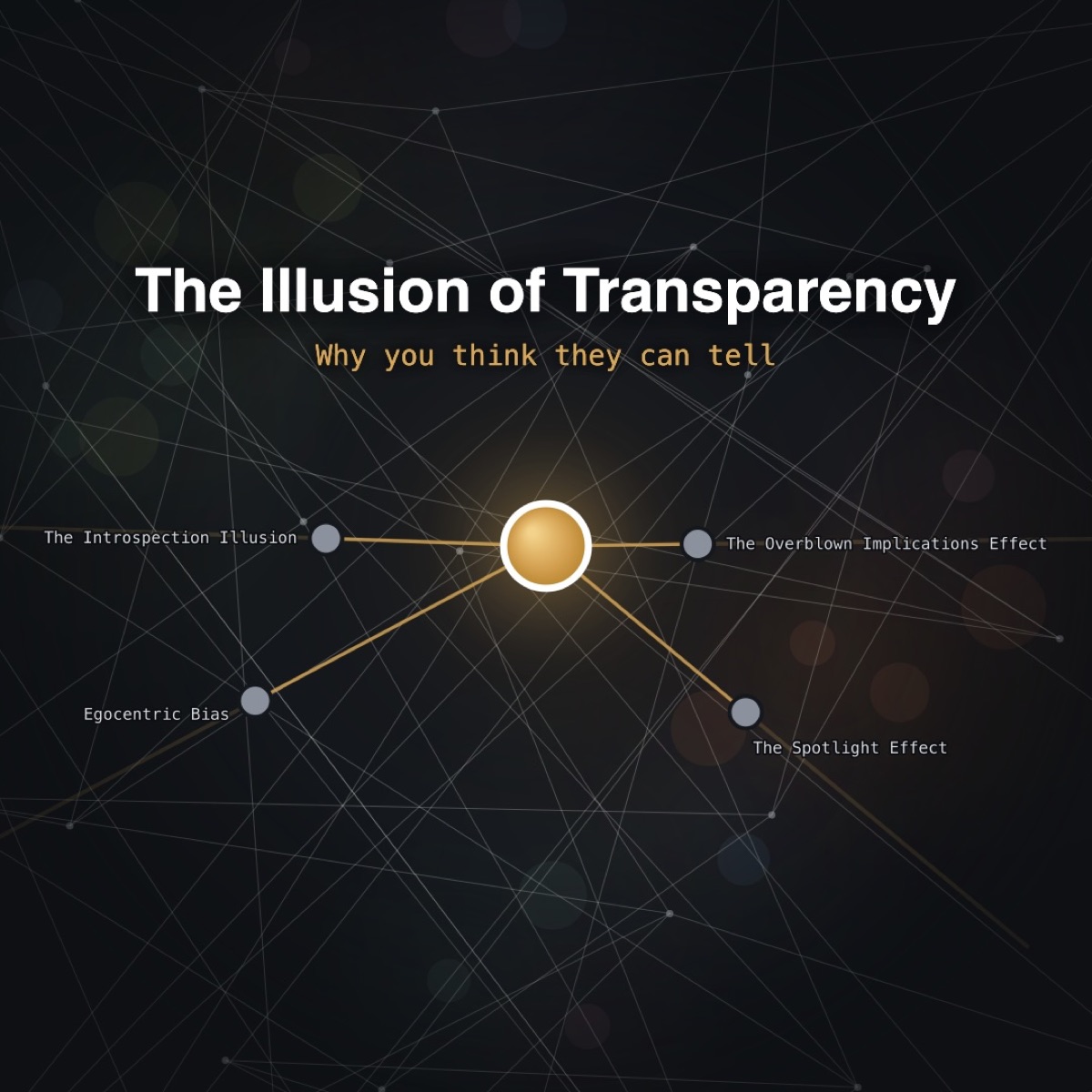
Your internal experience is loud and detailed from the inside. You have full access to the churn. Other people get a thin slice of behaviour and are mostly tracking what you are saying, not auditing your face for tremors. You anchor on the intensity of your own internal experience and adjust too little for the fact that everyone else sees only your outward behavior. The Spotlight Effect is about how much people notice you. The Illusion of Transparency is about how accurately they can read what you're feeling once they do.
Also shows up in
- Public speaking: the shake in your voice is real to you and largely inaudible to the audience.
- Negotiations: you think you've revealed your priorities or reservation point. The other side usually can't tell.
- Hard conversations: you assume the other person knows how upset you are so you don't say it. They miss it entirely.
- Interviews: nerves feel disqualifying and read, to the panel, as fairly normal.
Countermeasure
Trust that your feelings are not as visible as they feel and let the audience track the content instead of your inner weather. Before the moment that worries you, tell yourself plainly that whatever you're feeling is far less visible than it looks from inside your own head: speakers who do this rate their own performance higher and audiences rate it higher too. Afterwards, ask a trusted observer what they saw. Their read is usually more accurate than your fear.
Next time you feel exposed in a meeting, ask one person afterwards how you came across. Compare it to how it felt. That gap between how exposed you feel and how exposed you are is the bias itself.
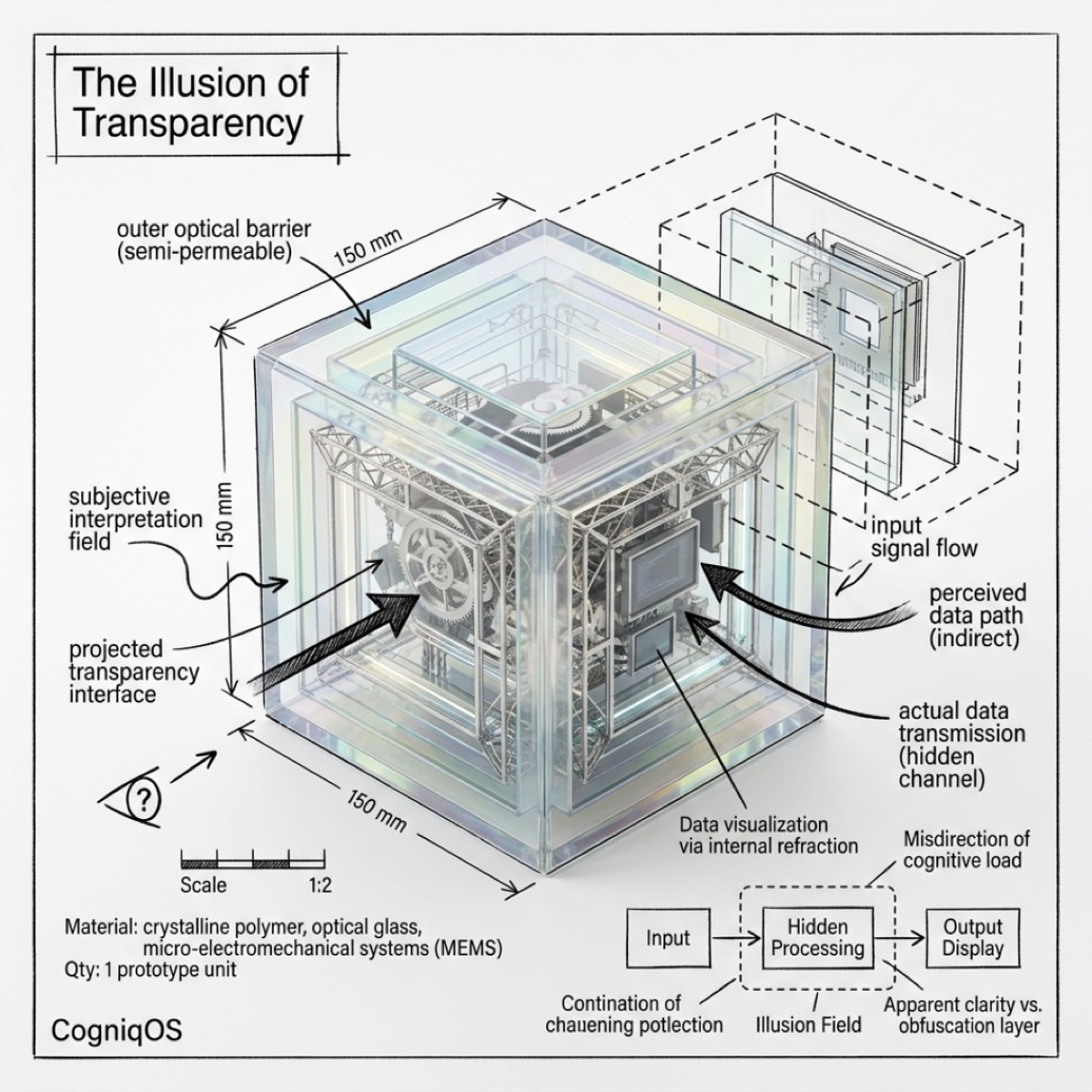
The state that feels broadcast is mostly a private channel. People are watching the words, not the wiring underneath them.
What have you not said lately because you assumed the other person could already tell?
CogniqOS publishes one cognitive trap per week. Forward this to someone who dreads public speaking.
If it landed, restack it.
Where it hurts most
- Relationships and management. The illusion makes people skip saying the thing out loud because they assume it is already obvious. The colleague does not know you are frustrated. The partner does not know you are hurt. You felt it so strongly you were sure it transmitted. It did not. The silence gets read as fine. Familiarity narrows the gap but doesn't erase it. Even people who know you well are still guessing from behavior, not plugged into your internal monologue. The cost is the conversation that never happened because you thought it already had.
When it doesn't apply
Some states do leak, especially to people who know you well and pretending you are a closed book can backfire. Close observers, repeated exposure and high-stakes settings all raise legibility. The illusion is about the gap between felt and visible, not a claim that you are invisible. Calibrate down, do not assume zero.
Danger zone
Spotlight Effect + Introspection Illusion + Illusion of Transparency - you overestimate how much attention is on you, trust your own read of why you feel what you feel, then assume that inner state is broadcasting outward so a private wobble becomes, in your head, a public verdict that no one else registered.
Stress test
A manager is silently furious about a missed deadline and says nothing direct, certain the tension is obvious. The report registers a slightly off meeting and moves on unchanged. Three weeks later the manager escalates, baffled that nothing improved. The signal that felt deafening was never received.
Testable prediction
If speakers rate how visible their nervousness was immediately after a talk and observers independently rate it, then speaker estimates reliably come out higher than observer ratings. In a typical workplace scenario, if a manager who is privately certain their frustration was obvious asks a report the same day what they picked up on, then the report names less than the manager assumed was showing.
Run this audit with your AI
Paste your decision in, and let your assistant audit it through this bias.
You are my CogniqOS transparency check. Bias lens: Illusion of Transparency.

MY SITUATION: [paste here]

One situation where you feel exposed, in a plain sentence - e.g. "I have to present to the board and I'm sure they'll see how nervous I am."

What am I avoiding or changing because of how exposed I feel and what does that cost me? (Required.)

(Optional: what specifically I think is showing.)

If another bias fits better, say so before auditing.

If my input is vague, ask me to sharpen it before auditing.

If it contains more than one decision, make me pick one first.

Audit:

1) Separate what I'm feeling internally from what an outside observer could detect.

2) Name what the audience is tracking (usually content) and what they're almost certainly not.

3) Tell me whether there's something I'm assuming is obvious that I should just say out loud instead.

Return as: the felt-vs-visible split + what the audience is tracking + the thing I should state explicitly.

Keep this in your stack. Next trap in the chain: Curse of Knowledge.
Related traps
- Spotlight Effect - You overestimate how much people are noticing you at all
- Introspection Illusion - You trust your read of your own inner causes more than you should
- Overblown Implications Effect - You assume one slip says more about you to others than it does
- Curse of Knowledge - Once you know your own state, you can't model not knowing it
Also connected in the mapThe Introspection Illusion·3 more, locked
Credit & first seen
PopularizedStudied by Thomas Gilovich, Kenneth Savitsky and Victoria Husted Medvec (1998) at Cornell University. source ↗
Sources
- Gilovich, T., Savitsky, K. & Medvec, V.H. (1998). The illusion of transparency: Biased assessments of others’ ability to read one’s emotional states. Journal of Personality and Social Psychology 75(2), 332-346
- Savitsky, K. & Gilovich, T. (2003). The illusion of transparency and the alleviation of speech anxiety. Journal of Experimental Social Psychology 39(6), 618-625
- Van Boven, L., Gilovich, T. & Medvec, V.H. (2003). The illusion of transparency in negotiations. Negotiation Journal 19(2), 117-131
Read next
Entry #141 of 631 in The Lexicon · see the full Lexicon