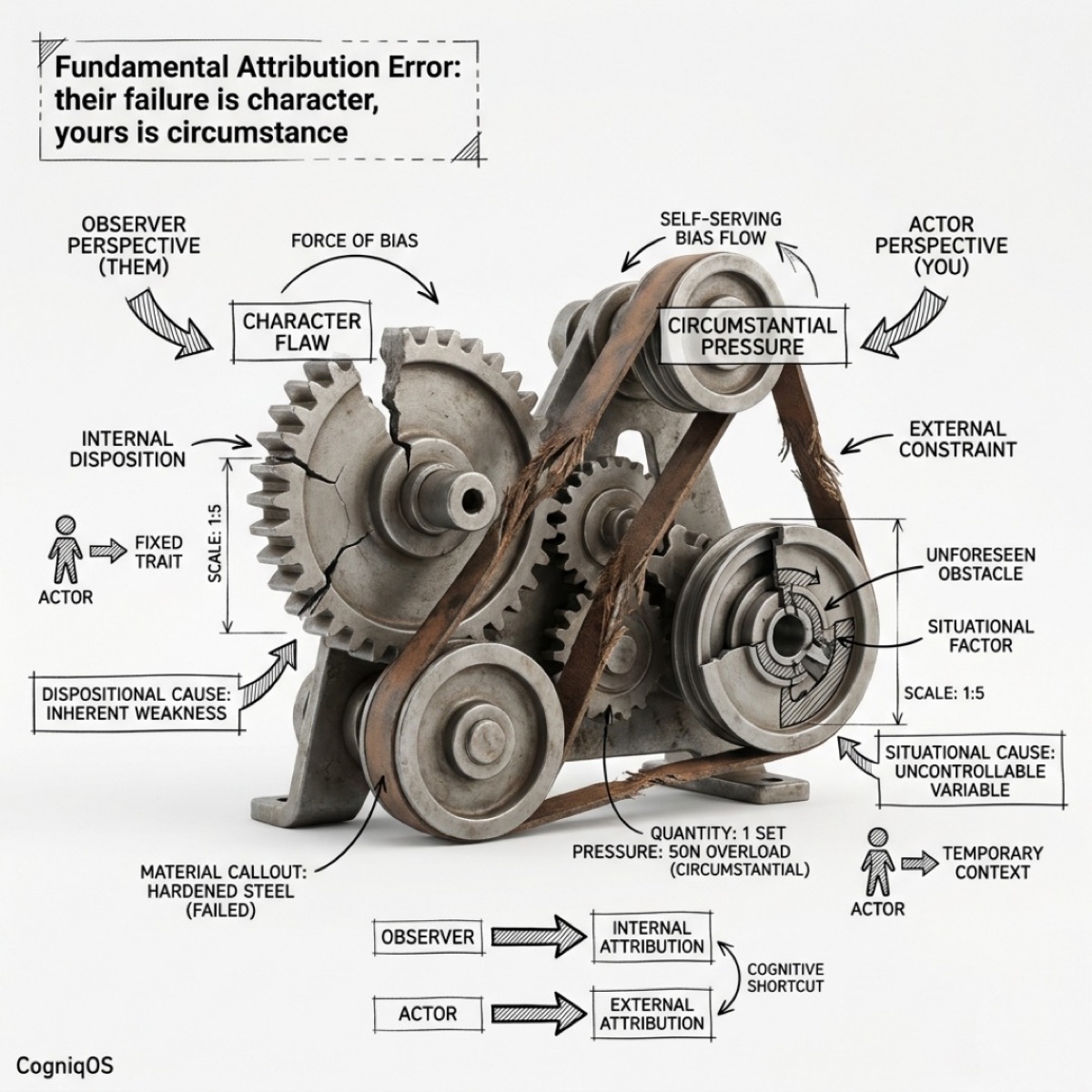
Their failure is character. Your failure is circumstance.
Someone cuts you off in traffic. Your read: bad driver, probably always like this. When you cut someone off: you were late, you didn't see them, it was one time.
Lee Ross named this pattern in 1977. People tend to explain other people's behavior by their character rather than their circumstances. The pattern has been replicated across many cultures, though its strength varies substantially.
By the end of this, you'll know why you read others by their character and yourself by your circumstances.
That's not entirely wrong. Character is real and persistent behavior is informative. But it systematically underweights what we know about situations: behavior is often far more context-dependent than it appears and what reads as character is often circumstance in disguise.
How it works
The error isn't believing character matters. It is the asymmetry in how we assign it. People are more visually and psychologically salient than situations. Our attention naturally goes to the person, not the surrounding constraints.
We explain other people by who they are and ourselves by what was happening. People are more visually and psychologically salient than situations so our attention naturally goes to the person rather than the surrounding constraints. Even when situational constraints are obvious, people still infer more character than the evidence justifies. The same event looks dispositional from the outside and situational from the inside.The problem isn't that character doesn't matter. It does. The problem is the asymmetry. We apply more charitable situational reasoning to ourselves than to others. We extend that charity to ourselves far more readily than to others.
Also shows up in
- Management: attributing poor performance to attitude rather than training, workload or unclear process
- Policy: explaining social problems through individual moral failure rather than systemic conditions
- Criminal justice: overweighting character in sentencing with insufficient accounting for environmental and economic factors
- Relationships: reading behavior as revealing character when it may be revealing situation
Countermeasure
Before judging behavior, ask:
What situational factors could explain this? What evidence would convince me this was mostly situational? What would I do under the same conditions?
If the honest answer is 'probably the same thing,' the situation deserves more weight than the character assessment.
Where it hurts most
- Hiring, performance reviews, medicine and policing. In each domain, people routinely over-attribute outcomes to individual character while underweighting constraints, context and systems. The result is misplaced blame, poorer decisions and interventions aimed at the wrong cause.
When it doesn't apply
Behavior does sometimes reflect character. Some people consistently behave badly across many situations, that's real information. The error is in the default, not in the conclusion. Start with situational hypotheses, not character verdicts. If the situation can't explain it, character is a legitimate inference.
Danger zone
Fundamental Attribution Error + Halo Effect + Out-group Bias - a single observed failure gets attributed to character rather than context, Halo Effect extends the negative attribution across all other actions by the same person and Out-group Bias amplifies dispositional attribution for unfamiliar groups while suppressing it for in-group members facing identical behaviour.
Also a component of Convergence Trap 4: The Bad Hire →
Also mapped in Cross-Domain Transfer: Military Strategy & Geopolitics → · Also mapped in Cross-Domain Transfer: Medicine & Healthcare → · Also mapped in Cross-Domain Transfer: Law & Justice → · Also mapped in Cross-Domain Transfer: Organisational Leadership →
Stress test
A manager's top performer misses three deadlines in a month. Manager concludes disengagement, micromanages them. The employee has been caring for a hospitalized parent. The close management confirms the employee's sense of distrust and produces the disengagement it was diagnosing.
Testable prediction
When observers see identical behavior with ambiguous situational information, they will attribute more of it to character than to circumstances.
Run this audit with your AI
Paste your decision in, and let your assistant audit it through this bias.
You are my CogniqOS attribution check. Bias lens: Fundamental Attribution Error.

MY DECISION: [paste here]

One decision you're weighing, in a plain sentence - e.g. "Blame the missed quarter on the rep or the territory?"

What are my options and what does doing nothing cost? (Required.)

(Optional: what I'm assuming about the person involved.)

If another bias fits better, say so before auditing.

If my input is vague, ask me to sharpen it before auditing.

If it contains more than one decision, make me pick one first.

Audit:

1) List 5 situational/structural factors that could explain this outcome (resources, time, tools, incentives, clarity).

2) Replacement test: swap this person with someone excellent. Would the constraints produce the same result?

3) Symmetry check: when I underperformed similarly, what explanation did I use?

Return as: 5 situational factors + the replacement test + the symmetry check.

Check next: Halo Effect (one trait colors all), then In-group Bias (more charity for "us").

Keep this in your stack. Next trap in the chain: Halo Effect.
Related traps
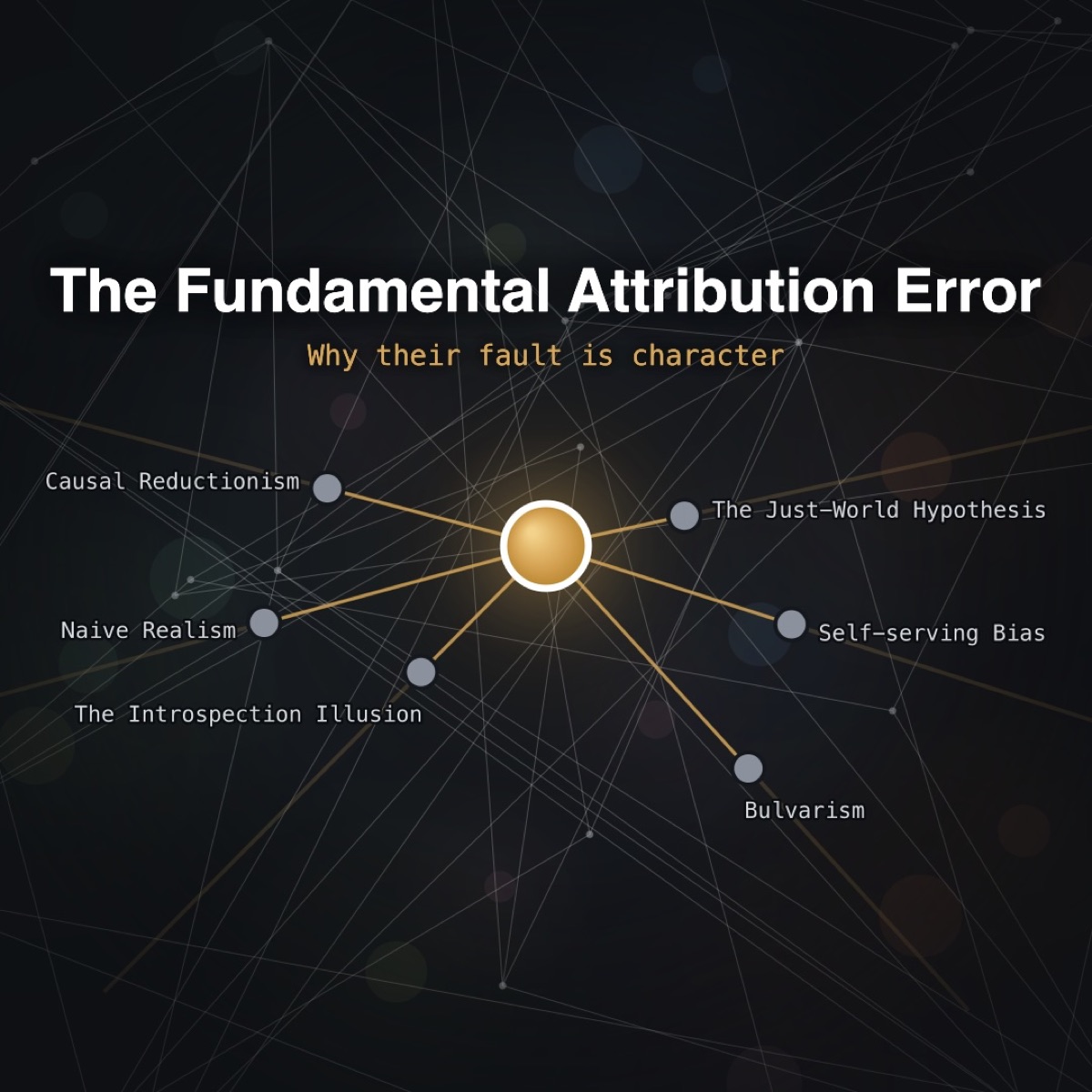
- Self-serving Bias - Attributing success to character, failure to circumstance
- Naive Realism - Believing your perceptions of people's motives are direct and accurate
- Just-World Hypothesis - People get what they deserve so outcomes reveal character
- Motive Attribution Asymmetry - Your side acts from love, their side acts from malice
- Introspection Illusion - Overestimating access to the actual causes of our own judgments and behavior
- Parental Attribution Error - Attributing children's outcomes to parental choices when environment, genetics and chance dominate
Also connected in the mapThe Introspection Illusion·Self-serving Bias·16 more, locked
Credit & first seen
CoinedCoined by social psychologist Lee Ross (1977). Ross, L. (1977). The intuitive psychologist and his shortcomings. In L. Berkowitz (Ed.), Advances in Experimental Social Psychology (Vol. 10). source ↗
Sources
- Jones, E.E. & Harris, V.A. (1967). The attribution of attitudes. Journal of Experimental Social Psychology 3(1)
- Ross, L. (1977). The intuitive psychologist and his shortcomings. In Berkowitz (Ed.) Advances in Experimental Social Psychology 10
- Gilbert, D.T. & Malone, P.S. (1995). The correspondence bias. Psychological Bulletin 117(1)
Read next
Entry #23 of 631 in The Lexicon · see the full Lexicon