The confidence you feel is the problem, not the evidence.
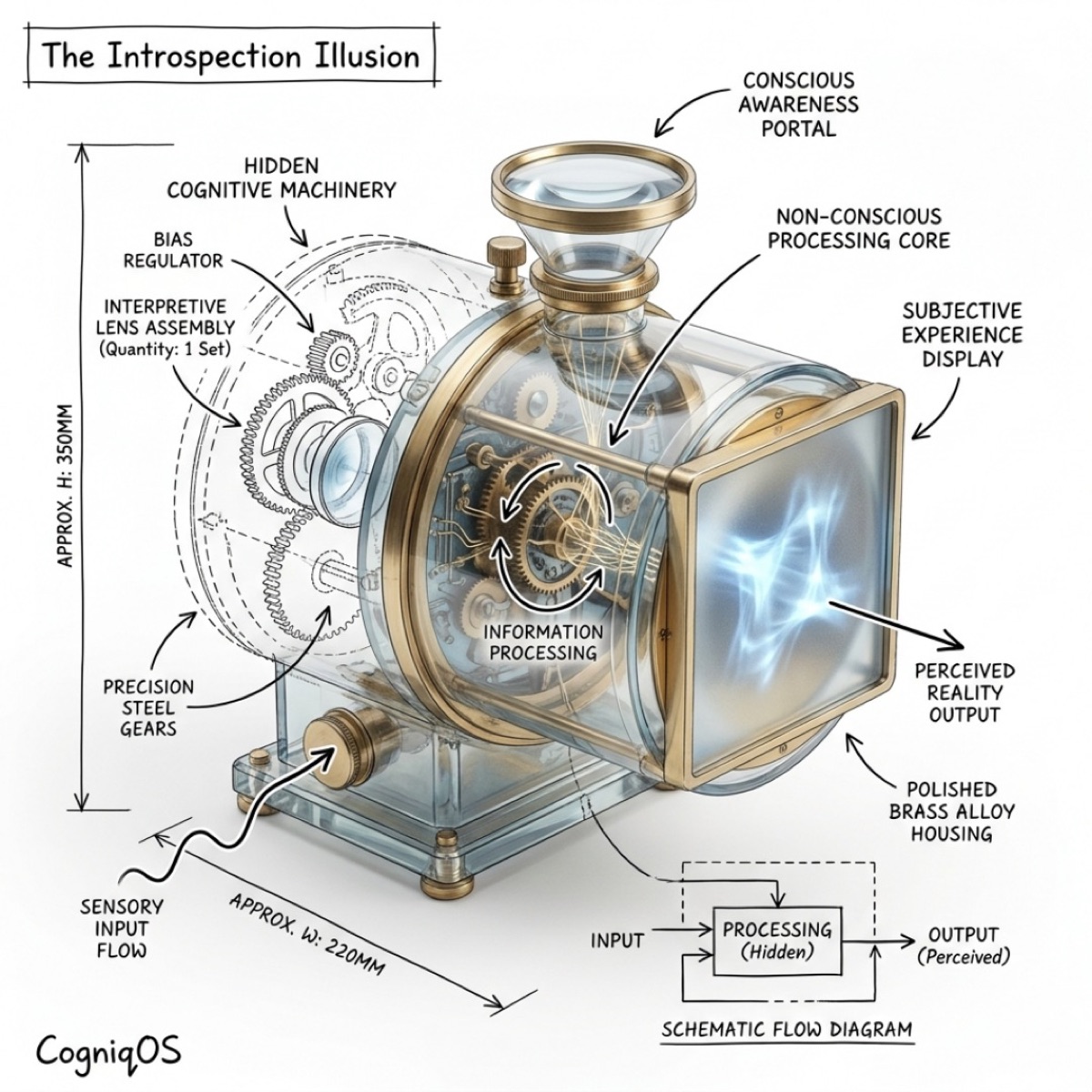
This is backwards, in two ways. When you ask why you did something, you may be reporting an inference about the cause rather than observing what produced it. And you extend trust asymmetrically: you weight your own introspection as privileged evidence while judging others by their behaviour. That asymmetry, which psychologists named when studying why we see bias in others but not ourselves, is the illusion. Constructed reasons are one way it gets its grip: because you never watch the construction, the account feels like something you found.
How it works
A foundational account comes from Nisbett and Wilson (1977), who argued people have little direct access to the processes behind their judgements and instead report a plausible-sounding theory. In their study, shoppers evaluating identical stockings preferred the rightmost item, then cited quality or texture and denied position mattered. Read it as evidence of limited awareness of an influence, not proof the whole explanation was invented.
A cleaner test comes from Johansson et al. (2005). Participants picked the more attractive of two faces, were handed the rejected one, then explained their preference for it. They often failed to detect the switch and gave confident reasons for the outcome they were shown - choice blindness. This shows people can miss a mismatch and still explain it, not that every ordinary explanation is confabulated.
The evidence is mixed and some accounts grant more genuine access to prior reasoning. In some decisions, though, influences like mood, fatigue and context affect the choice outside awareness while the explanation comes afterwards.
Also shows up in
- It is especially worth watching in high-stakes identity decisions where a clean story is most rewarded: choosing a partner, quitting a career, a purchase you need to defend. When a choice needs defending, a coherent reason is especially easy to mistake for an accurate one. The polish may reflect rehearsal rather than accuracy.
- Knowing about the illusion does not dissolve it: you cannot introspect your way out of an illusion about introspection, because the faculty you would use is the compromised one.
- A domain-specific amplifier: analysing your reasons can sometimes make a choice worse. Wilson and Schooler (1991) found that asking people to analyse why they preferred something reduced how well their choices matched expert ratings for strawberry jams and later college courses. Analysing reasons seems to pull attention toward criteria that are easy to articulate but less predictive of the outcome. Whether it extends beyond such preference tasks is unclear so treat it as domain-limited.
- Scope: this is about post-hoc reports. Decisions made slowly and without pressure to justify are more likely to involve genuine prior reasoning so introspective reports carry more weight there, though still as hypotheses, not proof.
Countermeasure
The revealed-preference check: whenever a decision is costly, hard to reverse or tied to your self-image, write the reason you would give, then list your last three to five comparable choices and ask whether the reason predicts the pattern or only decorates this one. When story and pattern disagree, weight the pattern as evidence about what you do, then ask what constraints, habits or opportunities might also explain it. Treat both as hypotheses, not verdicts. Time pressure and social visibility raise the risk too.
Where it hurts most
- Hiring: managers narrate confident reasons for decisions driven by fit or fatigue, then defend the narrative against contrary data (observational).
- Consumer decisions: people may overlook placement, framing or mood and explain a choice by its most accessible features instead.
- Relationships: partners give sincere but constructed reasons for withdrawal or attraction so conflict chases the story instead of the driver (observational).
When it doesn't apply
The narrative faculty is not a defect to be excised. Introspection gives you useful access to what you currently think or feel and the reasons you explicitly weighed; it is least reliable when asked to name the hidden causes of a choice. Coherent self-explanation also lets you communicate, coordinate and commit. Use it to generate hypotheses and set direction, never as the final court on causation: a good author, a poor auditor.
Danger zone
Bias Blind Spot + Self-serving Bias + the Introspection Illusion - together they let you construct a flattering reason and believe you alone see clearly. The mechanism is not simply additive. Self-serving Bias steers the narrative toward flattering content, the Introspection Illusion makes an inferred explanation feel like retrieved fact and Bias Blind Spot exempts you from the scrutiny you would apply to others. Each closes off a different exit so the account ends up wrong and unchallengeable.
Stress test
1. Take your last major purchase over a month's pay. Write the reason you gave, then list your last three purchases in that category. Does the reason predict the pattern or only decorate this one?
2. Before your last big relationship or job decision became explicit, what observable pattern had already shifted - contact, effort, spending, sleep, avoidance? Does the reason you now give fit that pattern or contradict it?
3. Name a value you claim drives you. What percentage of your last ten discretionary hours actually served it?
4. When someone challenges why you did something, do you get more certain as you defend it? Rising certainty under challenge can mean you are constructing and defending the reason, not just recalling it.
5. What new observation would make you revise this reason? If nothing would, you are defending it, not holding it.
Testable prediction
If people analyse why they prefer something before choosing, then in preference domains their choices match expert quality ratings less closely than choices made without that analysis, as in Wilson and Schooler (1991).
Run this audit with your AI
Paste your decision in, and let your assistant audit it through this bias.
Use this to audit a decision for the Introspection Illusion - the tendency to report a constructed narrative as the true cause of your action.

Scope note: most reliable for decisions that were costly, hard to reverse or tied to your self-image, with high justification pressure. For low-stakes or novel decisions, treat the output as exploratory, the effect is contested there. Do not assume behaviour reveals the true motive either; use it as one piece of evidence among others.

MY DECISION: [paste here]

Audit:

1. What reason am I giving for this decision, in one sentence?

2. If I look at my last three to five comparable choices, does that reason predict them or only this one?

3. What non-conscious drivers (mood, fatigue, who was in the room, framing, habit) were present when I decided?

4. What would I do differently if this reason turned out to be wrong and what observable change would I expect?

5. Does my certainty go up when someone challenges the reason? If so, I may be constructing and defending it, not recalling it.

6. What would a neutral observer with only my track record, not my explanation, predict I did and why?

Keep this in your stack. Next trap in the chain: The Affect Heuristic.
Related traps
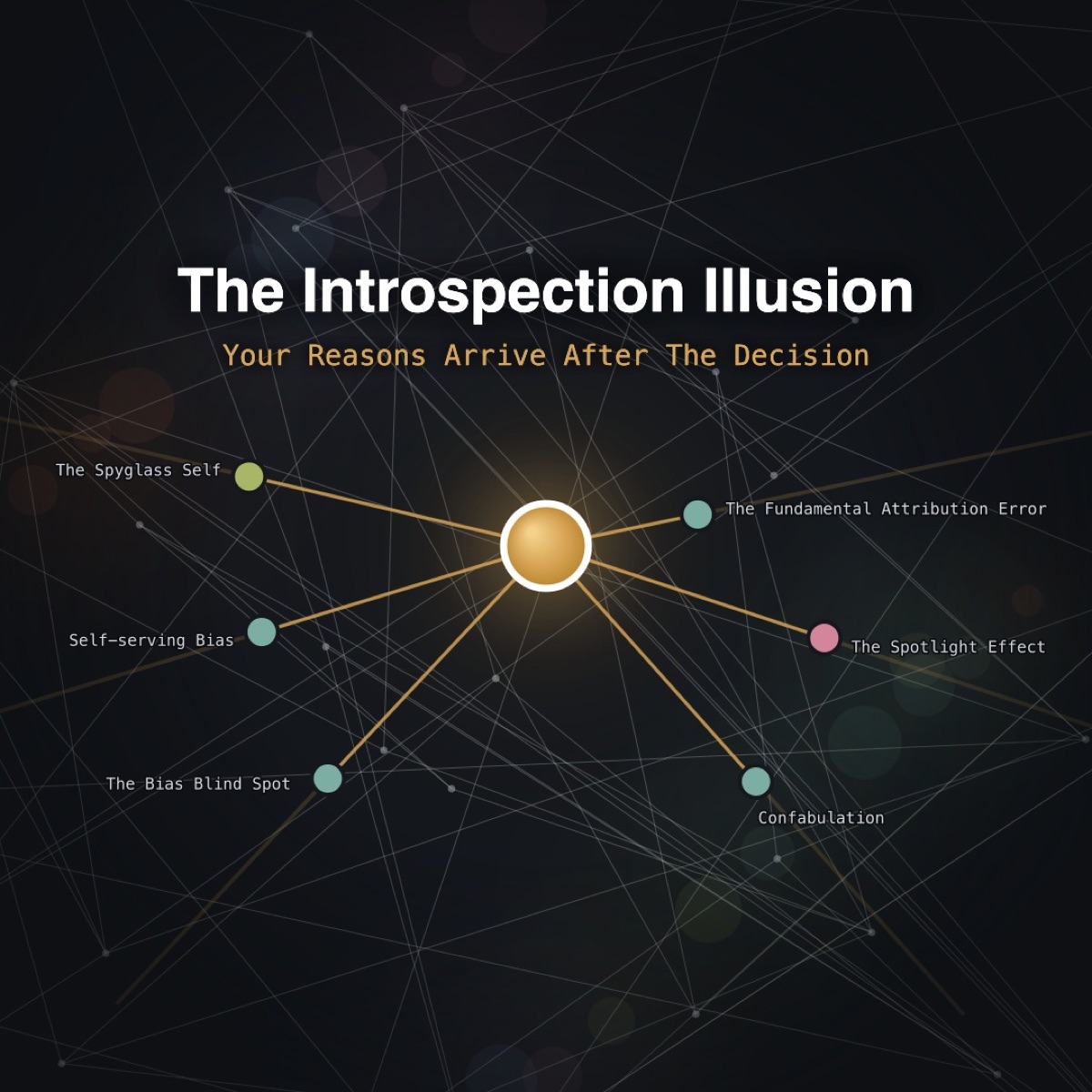
- Bias Blind Spot - you spot bias more readily in others than in yourself. The original research treated this asymmetry as a source of that blind spot: you scrutinise their motives while treating your own account as privileged evidence so the two reinforce each other.
- Self-serving Bias - it can steer the after-the-fact narrative toward reasons that flatter you.
- Fundamental Attribution Error - you may explain other people's behaviour by their character while explaining your own by circumstance, a related self-other asymmetry.
Also connected in the mapThe Bias Blind Spot·The Fundamental Attribution Error·Self-serving Bias·The Illusion of Transparency·Duping Delight·6 more, locked
Credit & first seen
PopularizedStudied by psychologist Timothy Wilson; discussed in his book Strangers to Ourselves (2002). source ↗
Sources
- Nisbett, R. and Wilson, T. 1977 - Telling More Than We Can Know: Verbal Reports on Mental Processes. Psychological Review.
- Wilson, T. and Schooler, J. 1991 - Thinking Too Much: Introspection Can Reduce the Quality of Preferences and Decisions. Journal of Personality and Social Psychology.
- Wilson, T. 2002 - Strangers to Ourselves: Discovering the Adaptive Unconscious. Harvard University Press.
- Johansson, P., Hall, L., Sikstrom, S. and Olsson, A. 2005 - Failure to Detect Mismatches Between Intention and Outcome in a Simple Decision Task. Science.
Read next
Entry #30 of 631 in The Lexicon · see the full Lexicon