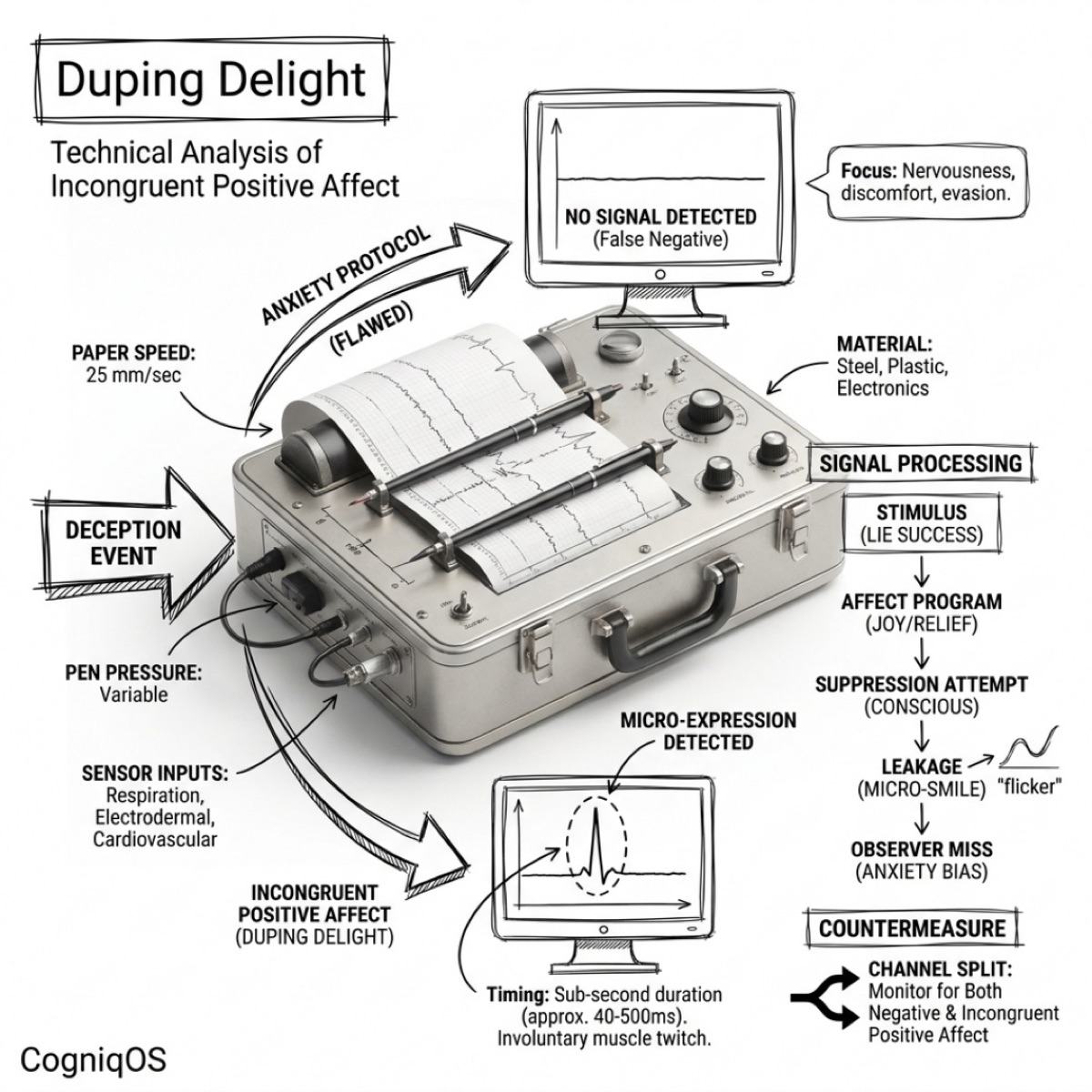
You were trained to spot nervousness. The liar knows that too. What you were never taught to watch for is the flicker of satisfaction when they realize it worked.
The commodity version of lie detection is anxiety-centric because anxiety is legible and culturally familiar. We expect guilt to look like guilt: downcast eyes, a nervous voice, visible discomfort. When a skilled deceiver shows none of these cues - because they are composed, because they have rehearsed, because they feel no guilt at all - the anxiety-trained observer concludes: nothing to see here.
But Paul Ekman's work on micro-expressions, beginning with research documented in Telling Lies (1985), identified a different class of signal entirely. [PULL QUOTE] Duping delight is not anxiety leaking through. It is pleasure leaking through - the involuntary, sub-second smile of someone who has just concluded that their deception is working. It is counter-intuitive precisely because it is positive affect in a context where we expect only negative affect.
How it works
The theoretical account rests on Ekman's model of affect programs - biologically based emotion systems that can generate facial expressions faster than voluntary suppression can intercept them. One account holds that when a person successfully deceives and registers that success, a brief positive emotion - something in the range of pride, relief or vicarious triumph - is generated before the deceiver's conscious suppression system engages. The result is a micro-expression: a full-face or partial smile lasting between 40 and 500 milliseconds, occurring in response to the wrong stimulus entirely.
Evidence for the effect as described is mixed. Ekman's original observational work was influential but has faced replication challenges; a 2006 meta-analysis by Bond and DePaulo found that unaided human lie detection performs near chance. What remains better supported is the narrower claim: micro-expressions exist as a measurable phenomenon and can be detected at above-chance rates by trained or slow-motion observers. The specific link to deception detection - rather than emotional concealment generally - carries a weaker evidentiary base and should be treated as a working model rather than settled finding.
The tell is not the lie - it is the pleasure of getting away with it.
The failure mode this creates is structural: if your entire detection framework is built around anxiety cues, you are not merely missing duping delight - you are actively producing false negatives for calm, confident and emotionally rewarded deceivers.
Also shows up in
- Duping delight fires hardest in high-stakes asymmetric interactions where one party has invested significantly in the deception and the other is not trained to look for positive affect. Three contexts amplify the risk:
- Formal investigative interviews where the interviewer signals their detection framework early. This gives the subject time to mask anxiety while letting pleasure go unmonitored.
- Legal depositions and recorded testimony, where slow-motion video analysis can later reveal what real-time observers missed.
- Negotiation and due diligence settings, where a counterpart who has successfully concealed information may show brief satisfaction before returning to a composed baseline.
- Knowing about duping delight does not reliably fix the detection problem. The signal is brief enough that even briefed observers miss it under real-time conditions. More practically: the knowledge creates a secondary error where observers begin over-attributing ordinary social smiles or nervous laughter to deceptive pleasure. The countermeasure must be procedural - not just awareness - because awareness alone under cognitive load tends to produce pattern-matching to the last thing learned rather than disciplined signal tracking.
Countermeasure
The operational adjustment is a deliberate channel split during any high-stakes evaluation. Do not monitor only for negative affect (anxiety, discomfort, evasion). Run a parallel audit specifically for incongruent positive affect.
The diagnostic question is precise: 'Is there any pleasure visible on this person's face that does not fit what they claim to feel right now?' This is different from asking whether they seem calm. Calm is the absence of anxiety. Duping delight is the presence of pleasure and the two are not the same state.
Specific protocol steps where feasible: • Record video of any high-stakes interview and review at reduced speed (0.25x or 0.5x) specifically scanning for positive micro-expressions during claimed emotional states (grief, shock, uncertainty). • Note the timing of any smile relative to what was just said or asked. A smile that follows the interviewer's apparent satisfaction is different from one that follows the subject's own statement. • Use a baseline window early in the interview to establish what positive affect looks like on this individual's face before evaluating later instances.
Threshold condition: this procedure is worth the cost only in high-stakes, low-trust evaluation settings. Applying it to routine social interactions produces observer error and social damage at a rate that is not worth the marginal detection gain.
Where it hurts most
- Legal and investigative: Interviewers trained exclusively on anxiety-based deception cues produce false negatives for composed, rewarded deceivers - a cost that compounds through wrongful clearances and missed prosecution opportunities (observational, based on documented limits of unaided detection performance).
- Corporate due diligence: In acquisition and partnership negotiations, a counterpart who has successfully concealed a material fact may briefly display positive affect at the moment of closure. This is a signal that post-hoc video review has sometimes flagged but real-time observers missed.
- Clinical and forensic assessment: Evidence suggests that trained clinicians using micro-expression tools outperform untrained clinicians at detecting concealed affect but the effect size is modest and the false-positive rate under time pressure remains a practical constraint.
When it doesn't apply
Not every incongruent smile is duping delight. Nervous laughter, relief after genuine stress, social mirroring and dark humor are all sources of positive affect that can appear at contextually wrong moments without indicating deception. A clinician who has just delivered bad news and observes a brief smile should not default to a deception read - the smile may reflect the patient's own coping mechanism or a moment of ironic recognition.
More broadly: micro-expression literacy is most valuable as a flag to trigger further inquiry - not as a standalone verdict. The appropriate response to detecting possible duping delight is not accusation. It is a redirect: ask a clarifying question, revisit the claim from a different angle and see whether the subject's affect pattern shifts. The detection is a hypothesis, not a finding.
Danger zone
Confirmation Bias + Authority Bias + Duping Delight - when an interviewer expects a high-status subject to be truthful and is already scanning only for anxiety, the positive micro-expression goes unrecognized. The subject's composure is misread as credibility, compounding both detection failures simultaneously.
Stress test
1. In the last significant negotiation you conducted, did you review any recording of the counterpart's face at the moment they agreed to terms - specifically looking for positive affect that did not match the gravity they expressed?
2. When you last concluded that someone was being honest because they 'seemed calm,' were you running a separate check for incongruent pleasure or only noting the absence of anxiety?
3. Think of a professional relationship where you later discovered you had been misled. In retrospect, do you recall any moment where the other party smiled or seemed briefly satisfied at a point that did not fit the context of the conversation?
4. Does your current framework for evaluating credibility in high-stakes conversations include any explicit protocol for detecting positive affect or only markers of stress and evasion?
5. If you were reviewing a recording of a colleague's client pitch and noticed a brief smile immediately after a specific claim, would you flag it for follow-up or attribute it to social warmth and move on?
Testable prediction
If interviewers are given explicit instruction to monitor for incongruent positive affect (in addition to anxiety), then their detection accuracy for prepared, low-anxiety deceivers should increase relative to anxiety-only trained controls - even if overall accuracy gains are modest. If a deceiver is told prior to an interaction that their interviewer is specifically trained to detect duping delight, then the frequency of observable positive micro-expressions during that interaction should decrease compared to an untold control group. This suggests that meta-awareness of the signal can partially suppress its occurrence under high-salience conditions.
Run this audit with your AI
Paste your decision in, and let your assistant audit it through this bias.
You are applying the CogniqOS framework for Duping Delight - the involuntary micro-expression of pleasure that a deceiver displays at the moment of successful deception and the systematic detection failure caused by monitoring only for anxiety cues.

MY DECISION: [paste here]

Audit:

1. In this interaction, was my detection framework built entirely around signs of anxiety, discomfort or evasion and did I have any active protocol for monitoring incongruent positive affect?

2. Was there any moment where the other party smiled, seemed briefly satisfied or displayed positive emotion that did not fit the stated emotional context and if so, did I investigate it or attribute it to social noise?

3. Did the counterpart appear unusually composed or low-anxiety in a way that I interpreted as credibility - when composure alone is not evidence of honesty?

4. If I had reviewed a slow-motion recording of the key moments of this interaction, is there any point at which I might have seen a positive micro-expression immediately following a specific claim?

5. Am I more confident in my credibility assessment because the person did not seem nervous - rather than because I had a positive protocol for detecting deception specifically?

6. What is the cost of a false negative in this context and does that cost justify adding an incongruent positive affect check to my standard evaluation process going forward?

Keep this in your stack. Next trap in the chain: Introspection Illusion.

Related traps
- Introspection Illusion - liars who are unaware of their own micro-expressions cannot deliberately suppress them, which is why duping delight persists even in practiced deceivers who believe their performance is controlled.
- Social Desirability Bias - the pressure to appear honest and appropriately distressed suppresses macro-level anxiety cues, which is precisely the condition under which a residual positive micro-expression becomes the most informative remaining signal.
- Confirmation Bias - observers looking for anxiety will find it or conclude it is absent; they will not spontaneously search for positive affect unless their detection protocol explicitly directs them to do so.
Also connected in the mapThe Introspection Illusion·2 more, locked
Credit & first seen
DiscoveredNamed and documented by psychologist Paul Ekman; discussed in Telling Lies (1985) and Emotions Revealed (2003). source ↗
Sources
- Ekman, Paul 1985 - Telling Lies: Clues to Deceit in the Marketplace, Politics, and Marriage. W. W. Norton.
- Ekman, Paul 2003 - Emotions Revealed: Recognizing Faces and Feelings to Improve Communication and Emotional Life. Times Books.
- Bond, Charles F. Jr. and DePaulo, Bella M. 2006 - Accuracy of Deception Judgments. Personality and Social Psychology Review, 10(3), 214-234.
- Porter, Stephen and ten Brinke, Leanne 2008 - Reading Between the Lies: Identifying Concealed and Falsified Emotions in Universal Facial Expressions. Psychological Science, 19(5), 508-514.
- Vrij, Aldert 2008 - Detecting Lies and Deceit: Pitfalls and Opportunities, Second Edition. Wiley.
Read next
Entry #212 of 631 in The Lexicon · see the full Lexicon