
You closed the deal because you're good. You lost the account because the client was impossible. Both explanations feel true. Neither is being tested.
The bias is not that people invent causes. It is that real causes are weighted differently depending on whether the outcome threatens or protects the self.
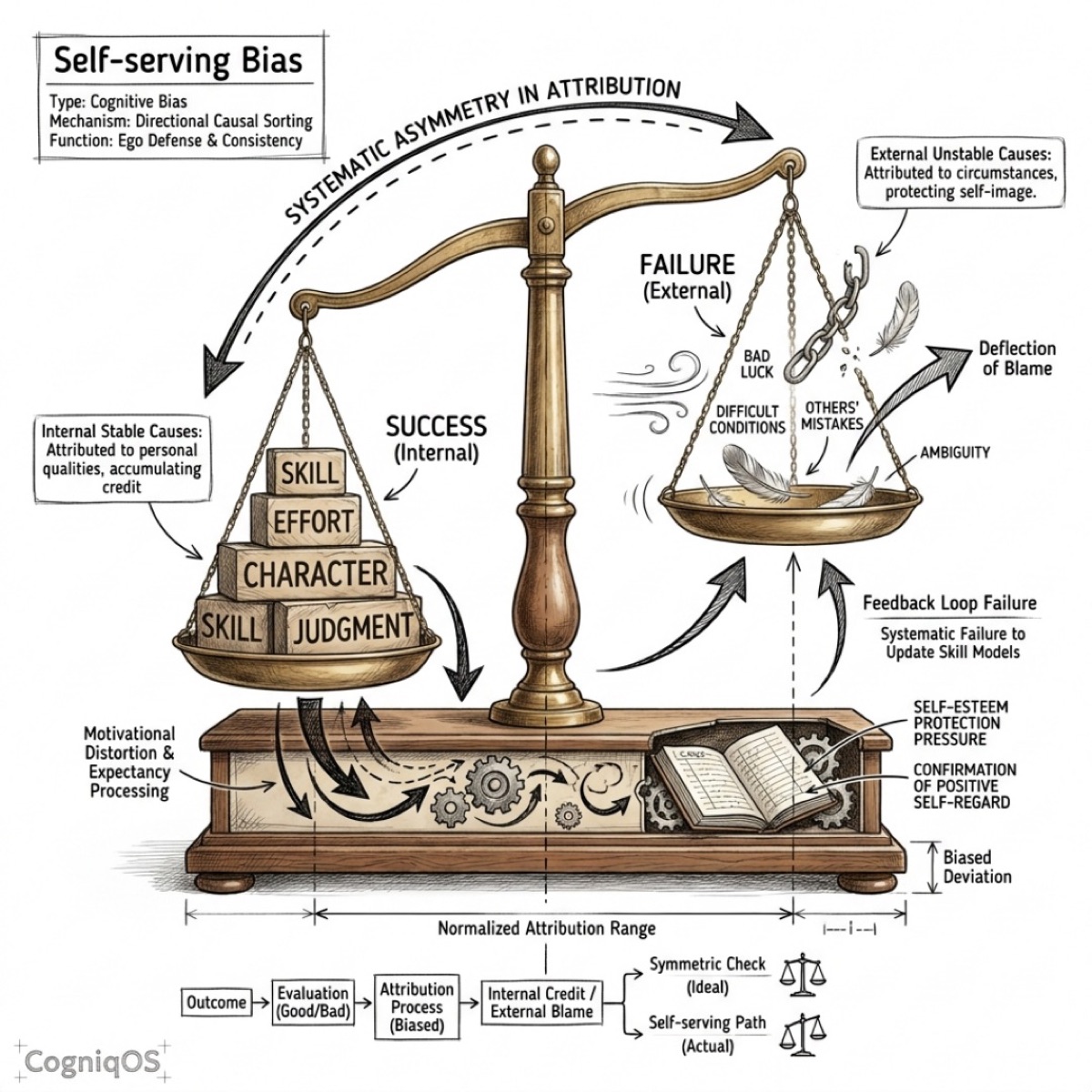
This misses the structure. It is not a character flaw layered on top of cognition. It is a systematic asymmetry in how attributions are assigned, robust across many contexts though its size varies by culture, ego threat and task structure. The direction of causal explanation shifts depending on whether the outcome was good or bad and you do not notice the shift.
The meme version also assumes that awareness corrects it. Research by Pronin, Lin and Ross in 2002 suggests that people who are explicitly informed about self-serving attribution continue to rate themselves as less biased than their peers, a finding sometimes called the bias blind spot. The insight does not defuse the mechanism. Awareness alone is usually insufficient. Knowing the name of the trap does not defuse it without a process tool attached.
How it works
The theoretical framework distinguishes two separable processes. First, expectancy-based processing: people expect to succeed. Success therefore confirms what was anticipated (internal attribution feels appropriate), while failure violates expectation (external attribution feels like an explanation rather than an excuse). Second, motivational distortion: protecting self-esteem creates pressure toward attributions that preserve positive self-regard. Miller and Ross (1975) reviewed the early evidence and were sceptical of the motivational account, finding stronger support for expectancy effects and limited evidence for self-protective distortion under failure. Zuckerman (1979) argued the motivational account is better supported than Miller and Ross allowed, particularly in ego-involving tasks.
The two accounts are not mutually exclusive. One leading explanatory model holds that both contribute, though their relative weight remains contested. The motivational account has stronger support in domains where ego is explicitly at stake (competitive performance, social evaluation) and weaker support in low-ego tasks. The expectancy account better predicts attribution in neutral laboratory settings.
The process produces a specific output: a person's causal vocabulary becomes directionally sorted. Internal stable causes (skill, character, effort, judgment) collect around successes. External unstable causes (market conditions, teammate failure, bad timing, ambiguous instructions) collect around failures. Over time, this sorting creates a ledger where the self accumulates credit and sheds blame and the ledger is internally consistent enough to feel like honest self-assessment.
Also shows up in
- Self-serving bias fires hardest in three contexts:
- Competitive environments where status is tied to performance signals (sales rankings, academic grades, promotion decisions)
- Collaborative work where credit and blame can be plausibly distributed across people
- Post-mortem reviews, where attribution is not just private but social and consequential
- In each of these, the asymmetric attribution pattern is both self-protective and interpersonally costly. When every team member attributes shared failures to others and shared successes to themselves, the aggregate attributions become arithmetically incoherent. Everyone was responsible for the win; no one was responsible for the loss.
- Knowing about self-serving bias does not reliably reduce it and may produce a secondary problem: people who are aware of the bias sometimes overcorrect in self-presentation (appearing falsely modest) while maintaining the original attribution privately. The behavior changes; the internal ledger does not. Cultural context also matters significantly - evidence from East Asian populations, where self-effacement norms are stronger, shows attenuated or reversed self-serving patterns in some studies (Mezulis et al., 2004), which means universality is overstated. The effect is strongest in some Western samples and smaller in some East Asian samples.
Countermeasure
The symmetric check is the operational tool. When you have produced an attribution, write one sentence naming the internal causes and one naming the external causes. Then run two forced reversals:
'If this outcome had gone the other way, would my causal story flip?' If yes, the attribution is serving self-image, not tracking causality.
'If someone else produced this outcome, would I use the same causal story I'm using for myself?' If not, you are applying different standards by direction and by actor.
The check works because it forces explicit counterfactual reasoning, which partially bypasses the motivated processing that generates the original attribution. Awareness of the bias name alone does not do this. The threshold condition for running it: any post-outcome explanation produced while the event is still emotionally salient. That is when self-serving attribution is most likely to operate unchecked. The check is not self-immune: under stress or high ego-involvement, a motivated reasoner can rationalise the reversal as convincingly as the original attribution. It reduces the bias. It does not eliminate it.
If your causal story flips with the outcome, it is probably tracking self-image at least as much as evidence.
As a pre-commitment protocol: before a high-stakes outcome is known, write down what you will credit if you succeed and what you will credit if you fail. Timestamp or date-lock the note. Without a timestamp, the prediction can be silently backfilled after the outcome is known, which defeats the protocol.
Where it hurts most
- Performance management: Managers who attribute team failures to personnel and team successes to their own leadership systematically underinvest in structural fixes.
- Investing and trading: Barber and Odean (2000) found that retail investors attribute gains to stock-picking skill and losses to market conditions. This self-serving attribution feeds overconfidence in future allocation decisions and insufficient position-sizing discipline.
- Medical and legal post-mortems: Zwaan et al. (2017) found that diagnostic errors were more frequently attributed to atypical patient presentations than to reasoning failures, which reduced uptake of corrective protocols.
- In many organisations self-serving attribution persists not because people lack understanding but because it is rewarded by status. The social incentive structure reinforces the bias faster than awareness corrects it.
When it doesn't apply
Moderate self-serving attribution appears to serve a stabilizing function under conditions of chronic external threat. In one research line, clinically depressed individuals show attenuated or absent self-serving bias, sometimes attributing failures internally and successes externally, a pattern called depressive realism (though the robustness of this finding is debated). Some degree of asymmetric attribution may buffer against rumination spirals following failure.
The adaptive case is narrow. Self-serving attribution is functional when the cost of demoralization exceeds the cost of miscalibration: short-duration, high-stakes contexts where morale matters and post-event correction is still possible. It becomes dysfunctional when it replaces that correction entirely.
A second adaptive case is anticipatory self-protection in genuinely high-variance environments: when outcomes are largely outside personal control, externalising failures reduces learned helplessness and preserves motivation to re-engage.
Danger zone
Confirmation Bias + Fundamental Attribution Error + Self-serving Bias - when all three operate together, confirmatory evidence for your own competence is weighted heavily, failures in others are attributed to their character and your own failures are attributed to circumstance, producing a closed epistemic loop in which no incoming information can revise the self-model downward.
Stress test
1. Think of the last project you led that underperformed. List the three causes you gave. How many were inside your control?
2. Think of the last time a colleague's project underperformed. Did you attribute it to their decisions or to conditions they faced? Compare that attribution structure to your answer above.
3. Before your last significant win, what did you predict would determine the outcome? Does your post-win attribution match that prediction or did new internal causes appear afterward?
4. Have you recently described a failure to a third party? Write down what you said. Now write the version where your decisions were the primary cause. Which account contains more actionable information?
5. In the domain where you consider yourself most skilled: what is the most recent evidence that you were wrong and where did you assign the cause?
Testable prediction
If people are asked to pre-register causal attributions before a competitive outcome is known, then post-outcome self-serving attribution will be measurably reduced compared to unprimed controls because the pre-commitment creates a reference point that makes retrospective revision detectable. This is falsified if pre-registered and unprimed groups show no measurable difference in post-outcome attribution. If organizational cultures reward accurate failure attribution over blame deflection, post-failure retrospectives will surface measurably more process-level corrective actions than cultures where failure attribution threatens status. This is falsified if the rate of process-level corrective actions is statistically indistinguishable across the two cultures.
Run this audit with your AI
Paste your decision in, and let your assistant audit it through this bias.
You are auditing a decision for self-serving bias, the systematic tendency to attribute successes to personal skill and character while attributing failures to external circumstances.

MY DECISION: [paste here]

Audit:

1. What causal explanation are you currently giving for this outcome? List the factors, mark each as internal (your skill, effort, judgment) or external (conditions, others, timing) and assign a percentage of total responsibility to internal versus external causes.

2. If you pre-registered your causal prediction before this outcome was known, does your current explanation match that prediction or did new causes appear after the result was clear?

3. If the outcome had been the opposite, success instead of failure or failure instead of success, would your causal list change direction? If yes, what does that tell you?

4. If a colleague had produced this exact outcome under identical conditions, would you use the same causal story? Where does your account diverge from what you would say about them?

5. What is the most significant internal factor you have not yet named? What would have to be true for that factor to have contributed?

6. What corrective action does your current attribution suggest? What corrective action would a fully internal attribution suggest? Are they the same?

Keep this in your stack. Next trap in the chain: Fundamental Attribution Error.

Related traps
- Fundamental Attribution Error - self-serving bias is about attribution for your own outcomes. FAE is about judging others. Together they produce a double standard: you externalise your failures while internalising others’ and neither feels like a bias.
- Dunning-Kruger Effect - self-serving attribution inflates the competence signal that feeds overconfidence, because failures that should update the skill model are credited away before they can register.
- Introspection Illusion - the conviction that you have privileged access to your own motives makes the self-serving origin of attributions harder to detect, since the explanation feels like genuine insight rather than motivated reasoning.
- Outcome Bias - judging a decision by how it turned out rather than by the quality of the process pairs directly with self-serving attribution. A good result gets credited to skill and skips scrutiny. A bad result gets externalised and also skips scrutiny. The decision process itself is never actually reviewed.
Also connected in the mapThe Fundamental Attribution Error·The Introspection Illusion·9 more, locked
Credit & first seen
DiscoveredMiller, D.T.&Ross, M. (1975).‘Self-serving biases in the attribution of causality.’Psychological Bulletin 82(2), 213-225 source ↗
Sources
- Miller, D.T. & Ross, M. 1975 - Self-serving biases in the attribution of causality: Fact or fiction? Psychological Bulletin, 82(2), 213-225.
- Pronin, E., Lin, D.Y. & Ross, L. 2002 - The bias blind spot: Perceptions of bias in self versus others. Personality and Social Psychology Bulletin, 28(3), 369-381.
- Mezulis, A.H., Abramson, L.Y., Hyde, J.S. & Hankin, B.L. 2004 - Is there a universal positivity bias in attributions? A meta-analytic review of individual, developmental, and cultural differences in the self-serving attributional bias. Psychological Bulletin, 130(5), 711-747.
- Zuckerman, M. 1979 - Attribution of success and failure revisited, or: The motivational bias is alive and well in attribution theory. Journal of Personality, 47(2), 245-287.
Read next
Entry #109 of 631 in The Lexicon · see the full Lexicon