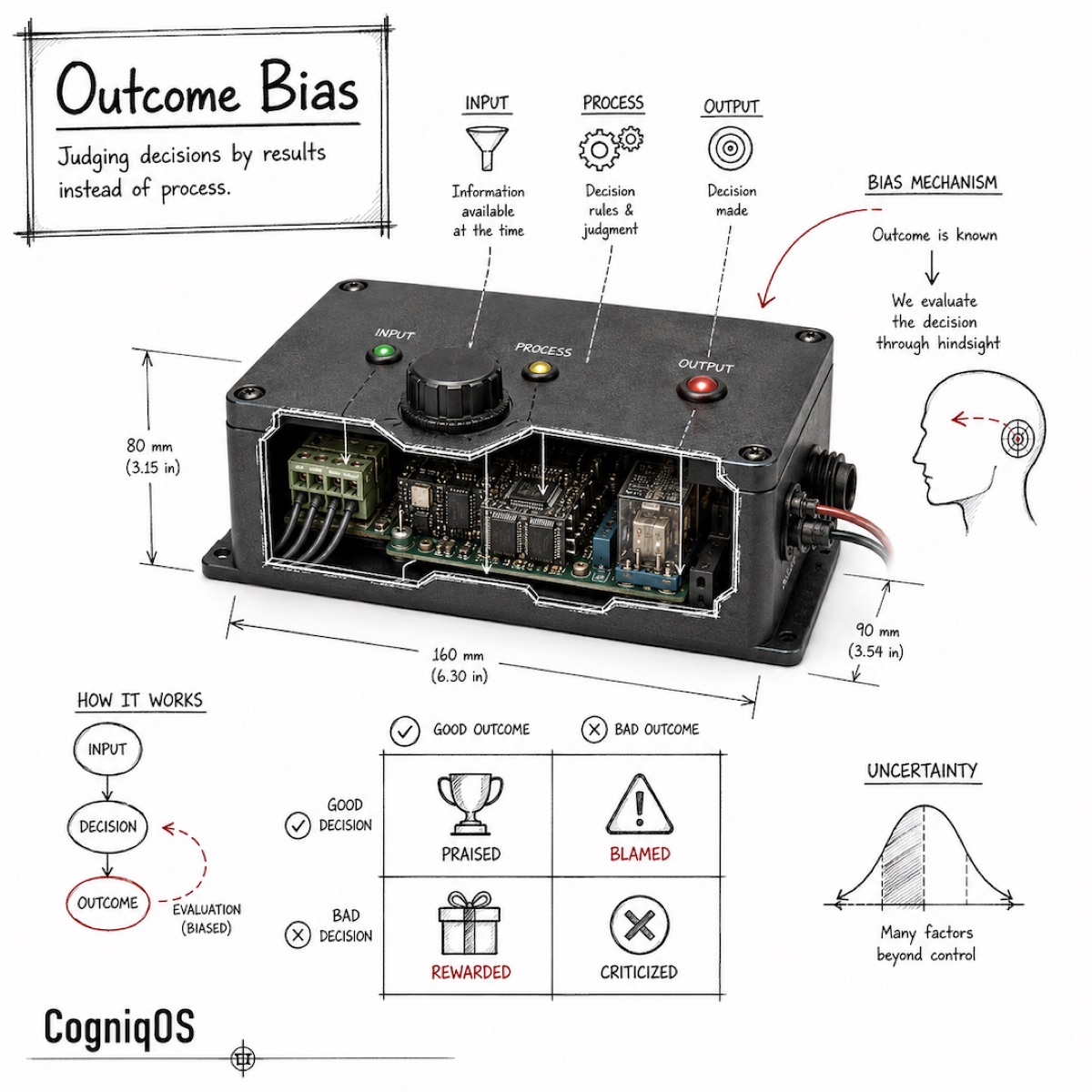
A risky call that paid off looks wise. The identical call that didn't looks reckless.
Two managers make decisions in the same quarter. One makes a thin bet on weak data and it happens to work. One makes a careful, evidence-based call and the market shifts and it fails. At review time the first gets promoted and the second gets a performance plan. The decisions were judged by their results, not by the thinking behind them.
By the end of this, you will know why outcomes hijack your evaluation of decisions and how to grade the process instead.
They speak. They lie about process. A decision is the thing you control. The outcome is the decision plus everything you did not control, including luck. Judging the decision purely by the outcome means rewarding good luck and punishing bad luck, then calling it accountability.
How it works
Once you know how it turned out, the result floods backward and recolours the decision. A success makes the reasoning look sharp even when it was sloppy. A failure makes sound reasoning look naive. The outcome is vivid and known; the quality of the thinking at the time is abstract and easy to overwrite. So you overwrite it.
This is Hindsight Bias pointed at decisions: not just I knew it all along - that was obviously a bad call, said only because you can see the ending.
Also shows up in
- Performance reviews: people graded on results that luck drove as much as skill.
- Case studies: a launch that succeeded despite a flawed strategy held up as a model - the wrong lesson gets copied.
- Medicine and law: a sound decision that ended badly judged as malpractice in hindsight.
- Investing: a reckless bet that paid off treated as proof of genius rather than variance.
Countermeasure
Evaluate the decision on what was knowable at the time - before the outcome comes in. What information existed? What options? What were the odds?
Take one decision that turned out badly and write down what you actually knew when you made it. Decide whether it was a bad decision or a bad result. They are not the same and you will be surprised how often you conflated them.
A good decision can lose and a bad decision can win. If you only score the scoreboard, you are training yourself to make lucky bets, not good ones.
CogniqOS publishes one cognitive trap per week. Forward this to whoever runs your post-mortems.
If it landed, restack it.
Where it hurts most
- Performance management across sports, finance and product. Decision-makers get rated on outcomes rather than process quality, which builds an incentive that rewards luck right alongside skill. The lucky gambler gets the budget; the unlucky careful operator gets cut. Over time the organisation selects for risk-blind boldness and then punishes the exact judgment it claims to want.
When it doesn't apply
Outcomes are not noise to be ignored. A pattern of bad results does signal a process problem, even when no single result does. The correction is not to disregard outcomes; it is to weight them properly relative to process and to judge individual decisions on what was knowable, while still using aggregate outcomes to audit whether the process is sound.
Danger zone
Affect Heuristic + Narrative Fallacy + Outcome Bias - a bad result carrying a compelling story locks in a wrong lesson as emotional truth, because the feeling of the outcome and the tidy causal story both bypass any cold re-examination of whether the decision itself was sound at the time it was made.
Also a component of Convergence Trap 10: The Narrative Trap →
Also mapped in Cross-Domain Transfer: Law & Justice →
Stress test
A surgeon recommends against operating on a high-risk patient, the family insists, the operation goes ahead and the patient survives. The same surgeon, same call, same odds, would have been blamed for cowardice had they refused and the patient later declined. Nothing about the quality of the judgement changed between those two worlds. Only the outcome did and the outcome is what the review board will weigh. Nothing about the decision quality changed between those two worlds. Outcome Bias ensures only the world that happened gets treated as obviously right.

Testable prediction
If evaluators are given identical decision descriptions that differ only in the stated outcome, then the version with the bad outcome is rated as a worse decision despite identical information at the time of choice. If evaluators are required to state what was knowable before the outcome before they rate the decision, then the outcome's effect on their rating decreases.
Run this audit with your AI
Paste your decision in, and let your assistant audit it through this bias.
You are my CogniqOS process-vs-outcome split. Bias lens: Outcome Bias.

MY DECISION: [paste here]

One decision you're judging by its result, in a plain sentence - e.g. "That hire failed - it was clearly a bad call."

What was actually knowable at the time, before the result came in? (Required.)

(Optional: what was actually knowable at the time the decision was made.)

If another bias fits better, name it first, then audit through that lens.

If my input is vague, ask me to sharpen it before auditing.

If it contains more than one decision, make me pick one first.

Audit:

1) Reconstruct what information and options existed at the moment of the decision, before the outcome was known.

2) Judge the reasoning on that basis alone: was it a sound process given what was knowable?

3) Separately, treat the outcome as one data point about the process, not the verdict on it.

Return as: the knowable-at-the-time picture + the process verdict + the outcome as a weighted input, not the judgment.

Check next: Self-serving Bias (you credit the wins, blame the losses on circumstance), then Moral Luck (blame for the uncontrollable).

Keep this in your stack. Next trap in the chain: Self-serving Bias.
Related traps
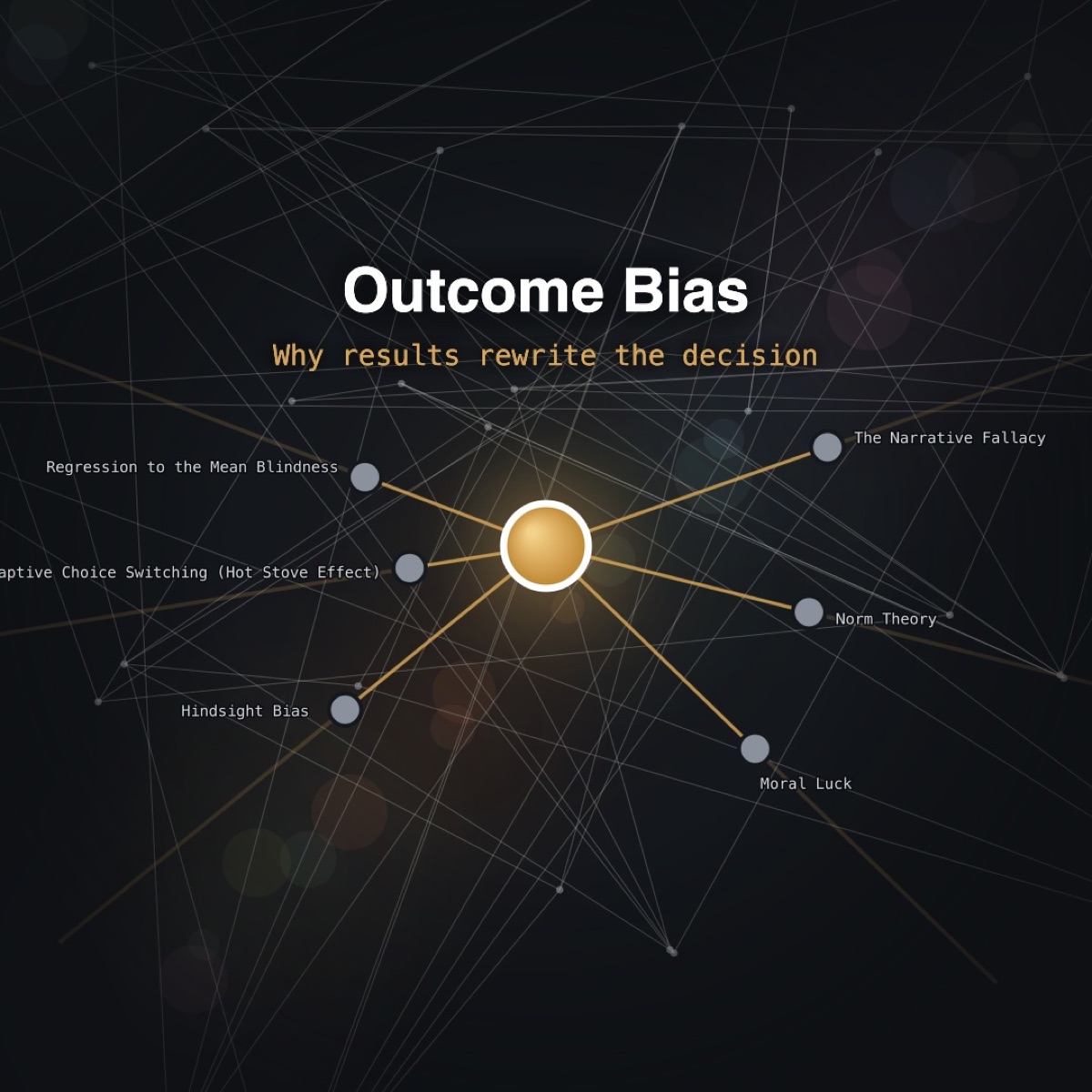
- Hindsight Bias - The parent effect: once you know the result, it feels like you always knew
- Moral Luck - We assign blame and praise for outcomes that were partly outside anyone's control
- Narrative Fallacy - A clean after-the-fact story makes the outcome feel inevitable
- Survivorship Bias - Studying only the outcomes that succeeded, with the failures deleted from view
Also connected in the mapHindsight Bias·The Narrative Fallacy·5 more, locked
Credit & first seen
DiscoveredKahneman, D. (2011). Thinking, Fast and Slow. Farrar, Straus and Giroux source ↗
Sources
- Baron, J. & Hershey, J.C. (1988). Outcome bias in decision evaluation. Journal of Personality and Social Psychology 54(4)
- Kahneman, D. (2011). Thinking, Fast and Slow. Farrar, Straus and Giroux
- Fischhoff, B. (1975). Hindsight is not equal to foresight. Journal of Experimental Psychology
Read next
Entry #38 of 631 in The Lexicon · see the full Lexicon