The bullet holes you see are the ones that didn't kill the plane. The popular version of this bias - we only see survivors - is roughly correct.
What it misses: we don't just overlook failures, we actively learn the wrong lessons from successes.
When a bank trains a machine learning model to identify creditworthy borrowers, it trains on historical loan data. That data only exists for people the bank previously approved. Everyone it rejected, including people who would have repaid, was deleted from the training set before the model ever saw it. The model learns to replicate the decisions that generated the data. It cannot correct them.
Abraham Wald identified the same structure in 1943. The US military nearly armoured the wrong parts of their bombers by studying bullet-hole patterns on planes that returned from missions. Wald pointed out: the missing data was the planes that didn't come back. Both failures share the same source.
You're drawing lessons from a dataset where failure was deleted before you arrived.
By the end of this, you'll know why the lessons you've absorbed about success may be missing half the data.

True. But the more important version: the failures aren't just overlooked, they're structurally absent from the data.
Success generates data; failure doesn't. The correction isn't humility. It's actively seeking the failure cases.
How it works
When a process selects for survival, the things that come out the other end aren't a random sample. They're a filtered one. Lessons drawn from them describe what survival looks like - not what causes it.
The identical strategy applied by a non-survivor produces no story, no case study, no book. The losers leave the dataset. The winners write the lessons.
Also shows up in
- Business books: case studies of market leaders, with no parallel collection of identical playbooks that failed
- Mutual funds: surviving funds report decades of returns; closed funds get quietly removed from the index
- Founder narratives: 'I dropped out and built a company' is told by the dropouts whose companies didn't fail
- Dating advice: comes from people whose approach worked, with no signal from those who tried the same thing and stayed single
Countermeasure
Before extracting a lesson, ask:
Where are the failures?
Search for the people, companies or funds that did the same thing and didn't make it. If their rate is high, the survivors' lessons may be noise.
The signal isn't in what worked. It's in what worked and what failed using the same approach.
Where it hurts most
- Investment strategies. Trading systems, diet protocols and management techniques that generate books and case studies are disproportionately drawn from survivors.
When it doesn't apply
Post-hoc analysis of success can still surface useful patterns. Provided the analyst goes looking for the failure cases that used the same approach. Survivor data isn't useless. It's missing the losses that would reverse the lesson.
Danger zone
Survivorship Bias + Confirmation Bias + Availability Heuristic - success stories are visible and emotionally memorable, Confirmation Bias screens out failures that contradict the pattern and Availability Heuristic makes the selected sample feel like the full population, producing strategy built on a dataset where failure was deleted.
Also mapped in Cross-Domain Transfer: AI Systems & Machine Learning →
Stress test
Business school, 12 case studies of market leaders. Students learn the patterns that produce dominance. No cases of companies that followed identical strategies and failed. The dataset has no losses. The lesson isn't wrong - it's missing half the evidence.
Testable prediction
If investors are shown return distributions that include discontinued funds alongside active ones, then their risk estimates are higher and expected-return estimates are lower compared to investors shown only active funds and the difference persists after controlling for financial literacy.
Run this audit with your AI
Paste your decision in, and let your assistant audit it through this bias.
You are my CogniqOS survivorship filter. Bias lens: Survivorship Bias.

MY DECISION: [paste here]

One decision you're weighing, in a plain sentence - e.g. "Copy the playbook that worked for that one breakout competitor?"

What are my options and what does doing nothing cost? (Required.)

(Optional: the success stories I'm modeling this on.)

If another bias fits better, say so before auditing.

If my input is vague, ask me to sharpen it before auditing.

If it contains more than one decision, make me pick one first.

Audit:

1) Name the survivors being cited. For every success, how many tried the same approach and failed? If I can't see the failures, I'm reasoning from a censored sample, say so.

2) List 3 hidden variables the survivors had that aren't part of the strategy I'm copying.

3) What did the failures look like? Same strategy, different outcome?

Return as: the unseen failures + 3 hidden survivor variables + the verdict.

Check next: Narrative Fallacy (the story hides the dead), then Outcome Bias (it judges by result alone).

Keep this in your stack. Next trap in the chain: Narrative Fallacy.

Related traps
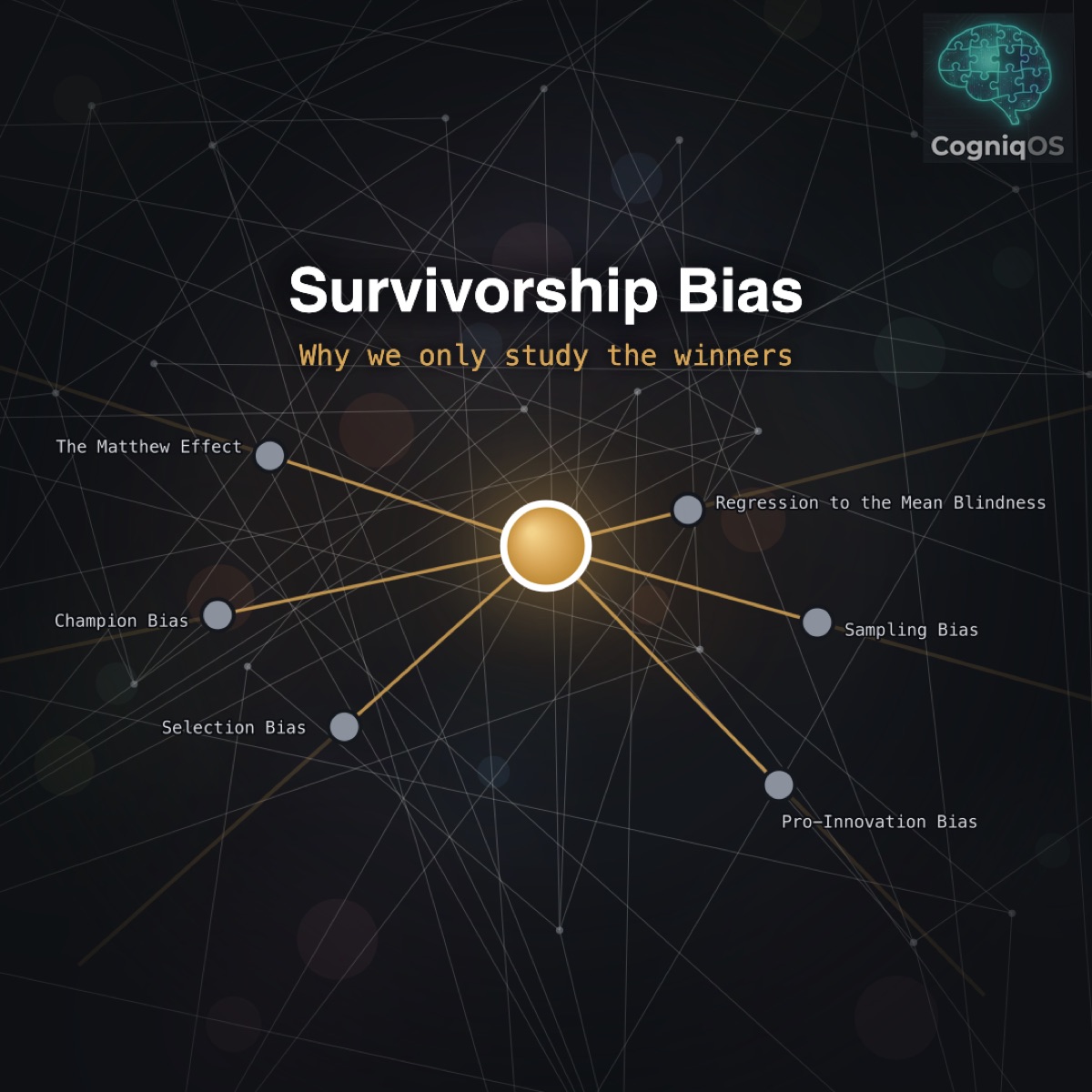
- Champion Bias - Over-weighting the winners' attributes
- Regression to the Mean Blindness - Mistaking luck for skill
- Matthew Effect - Early advantages compound, distorting the comparison
Also connected in the map11 more, locked
Credit & first seen
DiscoveredWald, A. (1945).Sequential tests of statistical hypotheses. Annals of Mathematical Statistics 16(2), 117-186 source ↗
Sources
- Wald, A. (1943/1980). A method of estimating plane vulnerability based on damage of survivors. Center for Naval Analyses
- Mangel, M. & Samaniego, F.J. (1984). Abraham Wald's work on aircraft survivability. Journal of the American Statistical Association 79(386)
- Brown, S.J., Goetzmann, W., Ibbotson, R.G. & Ross, S.A. (1992). Survivorship bias in performance studies. The Review of Financial Studies 5(4)
Also revealed
Entry #276 of 631 in The Lexicon · see the full Lexicon