
You didn't see it coming, you just think you did.
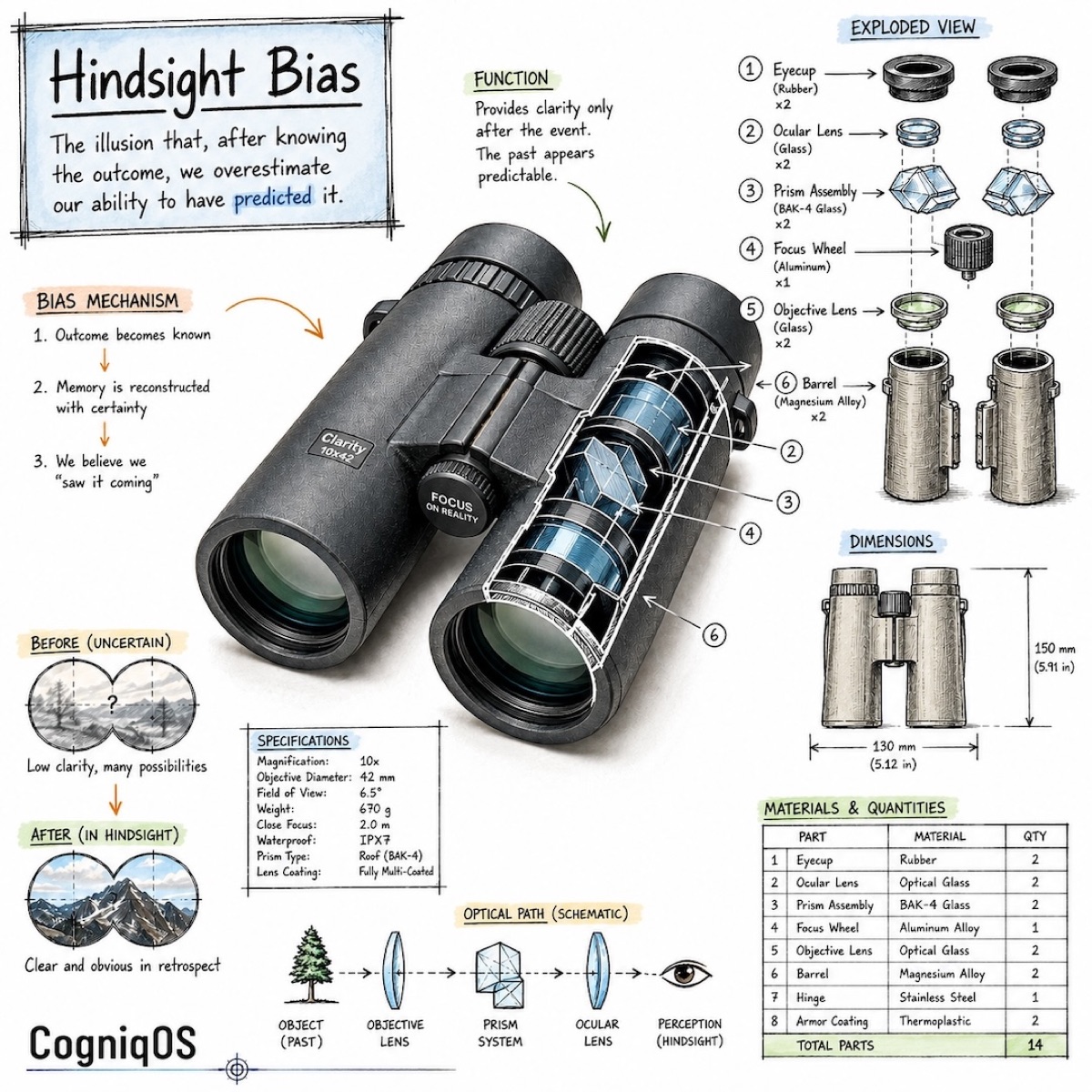
Baruch Fischhoff documented the effect in 1975. Once an outcome is known, people struggle to accurately reconstruct their prior uncertainty. Their remembered estimate shifts toward the actual outcome and the outcome feels inevitable in retrospect. The feeling isn't dishonest. The memory is reconstructed in light of the outcome.
This makes it corrosive for learning from experience. You need accurate memories of your prior state to extract good lessons from outcomes. Hindsight bias corrupts that memory reliably and in a specific direction.
By the end of this, you'll know why outcomes feel inevitable in hindsight. And what that does to learning and accountability.
That's the meme version. The feeling of retrospective clarity that makes the past seem predictable and the people who missed it seem foolish. The problem is that the clarity wasn't available in advance. It arrived with the outcome.
How it works
Learning from experience requires accurate memory of your prior state. What did I believe before this happened? What was I uncertain about? Hindsight bias corrupts exactly that memory, reliably, in the direction that makes outcomes seem more predictable than they were.
It's hard to extract the right lesson from an outcome if you can't remember what you thought going in.
Also shows up in
- Elections: 'the result was obvious' from people who didn't say so before
- Investment: 'we should have seen the crash coming' after the crash. In 2007 the housing bubble was one signal among dozens. By 2009 it was the only one anyone remembered watching
- Startup pivots: 'it was obvious the original direction wouldn't work'. From people who funded it
- Product failures: 'the market rejection was predictable' after the rejection
- Accident investigation: warning signs that were genuinely ambiguous before become unmistakably clear after
Countermeasure
Write predictions down before outcomes are known. This is the most reliable protection. You can't easily rewrite a record that already exists.
A prediction log kept over time also produces the calibration data needed to learn from outcomes, rather than from the hindsight-distorted version of them.
Before any outcome you're anticipating this week, write down your actual prediction and your confidence level. You'll need the record to check yourself after.
Format: "I expect X. Confidence: 65%. If I'm wrong, it'll be because Y." Date it. Don't edit it after the outcome lands.
Where it hurts most
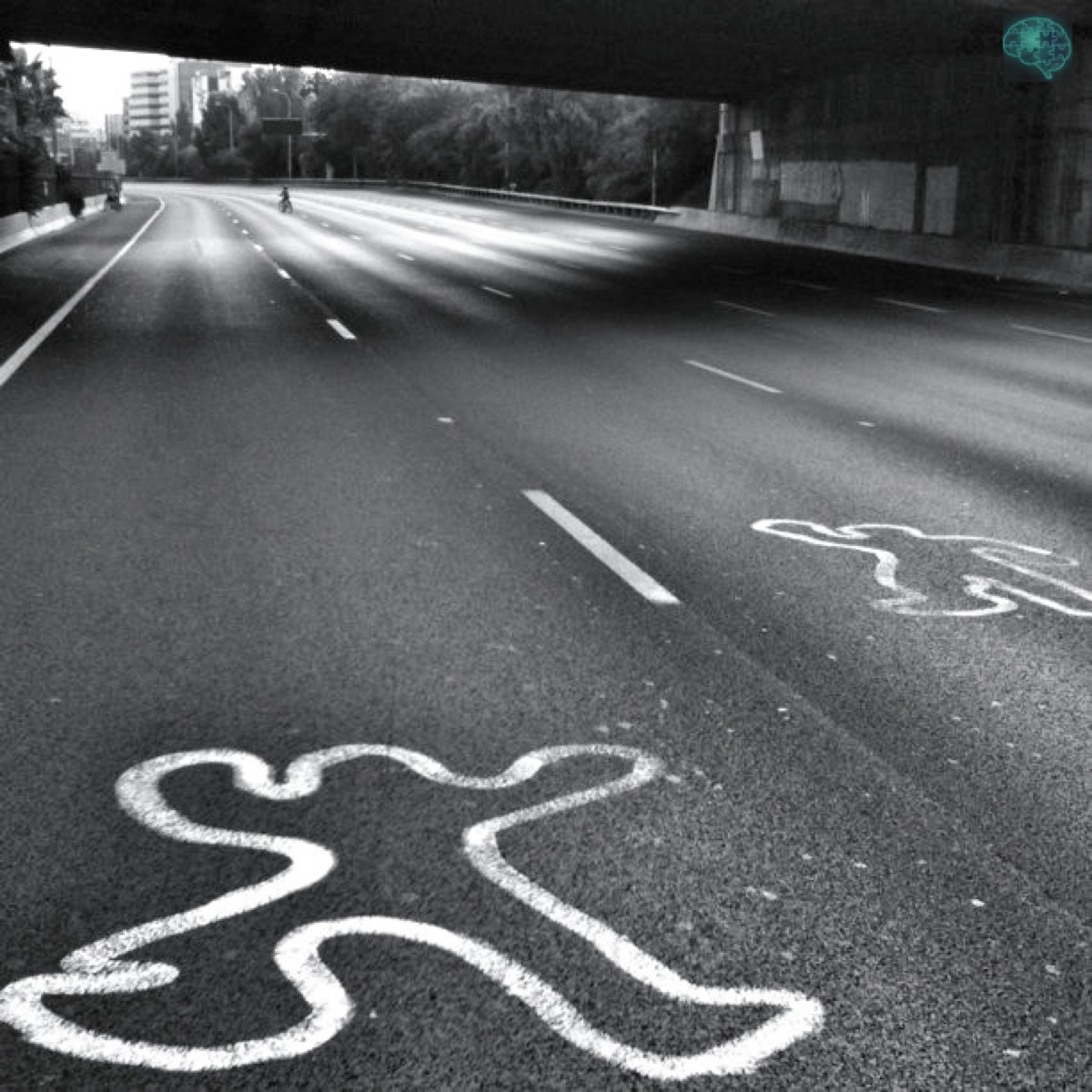
- Accident investigation. Post-hoc analyses of industrial accidents consistently identify warning signs that were not acted upon before the event. Prospective analysis of the same signals - before knowing the outcome - rarely produces the same clarity. The warnings were real. But they were one of many signals competing for attention. Hindsight makes them seem uniquely salient. And that distortion leads to the wrong lessons about why accidents happen.
When it doesn't apply
Some outcomes genuinely were predictable and the signal was genuinely there before the event. Not every 'I knew it' is hindsight bias. The question is whether the person recorded that prediction before the outcome and whether their uncertainty at the time matches what they now remember. Without written records, the distinction is impossible to make cleanly.
Danger zone
Hindsight Bias + Outcome Bias + Overconfidence Effect - knowing the result makes the path feel inevitable, Outcome Bias judges decision quality by its result rather than the information available at decision time and Overconfidence compounds on the feeling of having known to produce unjustified certainty about future predictions.
Also a component of Convergence Trap 10: The Narrative Trap →
Also mapped in Cross-Domain Transfer: Law & Justice →
Stress test
Post-mortem on a failed product launch lists six indicators that "predicted" failure. Four of those six were also present in three previous launches that succeeded. They were not predictive signals - they were background noise that became signal only after the outcome selected them.
Testable prediction
If you assess an outcome in an unfamiliar domain, then your recalled estimate shifts further toward the result than in a familiar one - hindsight bias shrinks as experience grows (Christensen-Szalanski & Willham, 1991, meta-analysis of 122 studies). Writing predictions down beforehand is the only intervention that reliably prevents the shift.
Run this audit with your AI
Paste your decision in, and let your assistant audit it through this bias.
You are my CogniqOS hindsight neutralizer. Bias lens: Hindsight Bias.

MY DECISION: [paste here]

One decision you're weighing, in a plain sentence - e.g. "Treat the outcome as obvious now that I know how it ended?"

What are my options and what does doing nothing cost? What do I claim I knew beforehand?

If another bias fits better, say so before auditing.

If my input is vague, ask me to sharpen it before auditing.

If it contains more than one decision, make me pick one first.

If I'm using hindsight to make myself look smarter than I was, point that out.

Audit:

1) Information freeze: list only what was known at decision time. Remove all post-outcome information.

2) Predictability test: given only pre-decision info, would most reasonable people have predicted this? Under 70% means it wasn't obvious. If I can't reconstruct what was knowable then, say so rather than guess.

3) Process vs. outcome: evaluate the decision process independently of the result.

Return as: what was known at the time + the predictability score + the process verdict.

Check next: Outcome Bias (it judges by result), then Narrative Fallacy (it builds the "obvious" story).

Keep this in your stack. Next trap in the chain: Outcome Bias.
Related traps
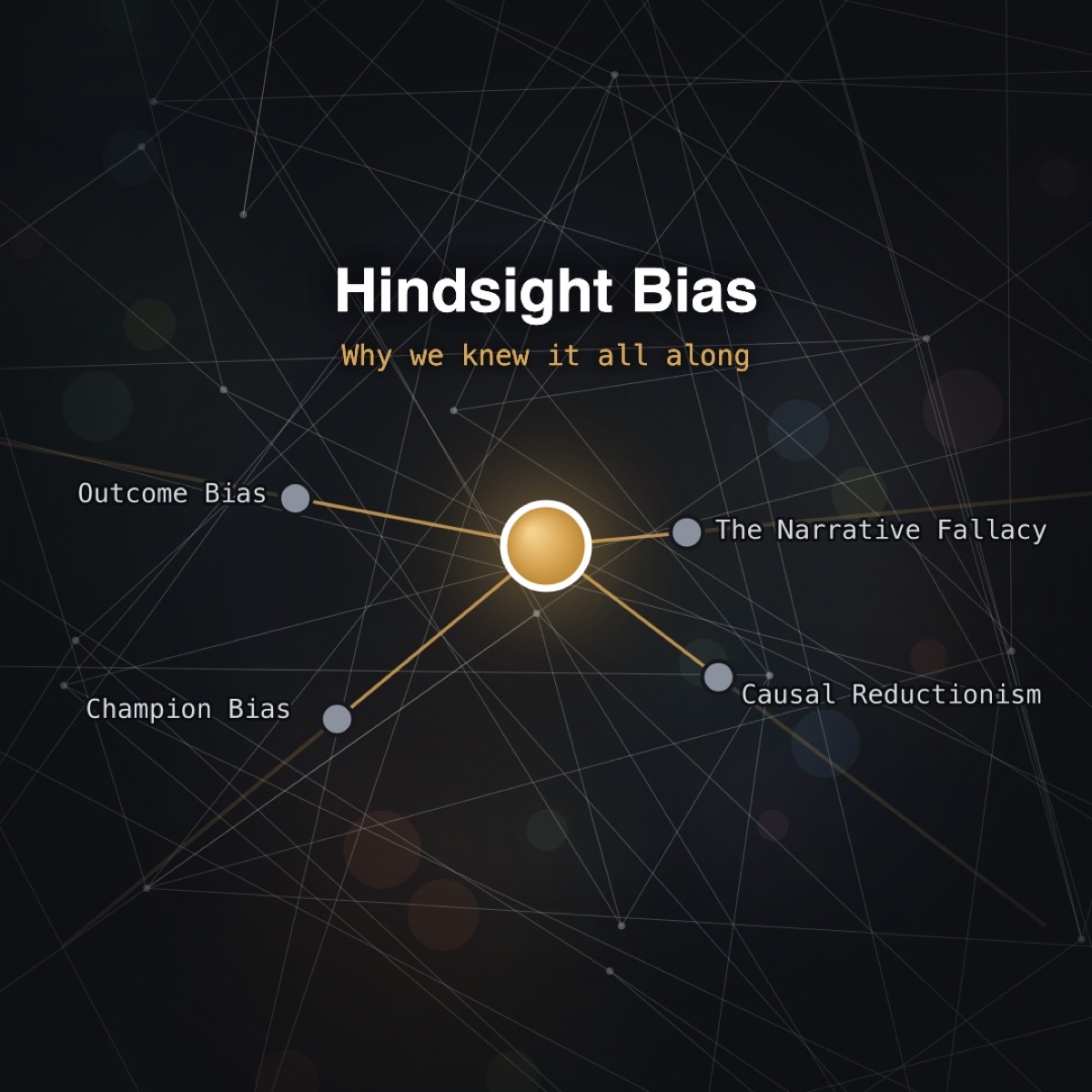
- Outcome Bias - Judging the quality of decisions by their outcomes rather than the reasoning that produced them
- Narrative Fallacy - Constructing causal stories from outcome sequences
- Illusion of Understanding - Believing past events are well-explained when they may have been largely chance
Also connected in the mapThe Narrative Fallacy·Outcome Bias·2 more, locked
Credit & first seen
DiscoveredFischhoff, B. (1975).Hindsight is not equal to foresight.Journal of Experimental Psychology: Human Perception and Performance 1(3), 288-299 source ↗
Sources
- Fischhoff, B. (1975). Hindsight is not equal to foresight: The effect of outcome knowledge on judgment under uncertainty. Journal of Experimental Psychology: Human Perception and Performance 1(3), 288-299
- Fischhoff, B. & Beyth, R. (1975). I knew it would happen: Remembered probabilities of once-future things. Organizational Behavior and Human Performance 13(1)
- Roese, N.J. & Vohs, K.D. (2012). Hindsight bias. Perspectives on Psychological Science 7(5)
- Christensen-Szalanski, J.J. & Willham, C.F. (1991). The hindsight bias: A meta-analysis. Organizational Behavior and Human Decision Processes 48(1), 147-168
Read next
Entry #26 of 631 in The Lexicon · see the full Lexicon